
Summary:
Most guides that compare RO systems and whole house filters are written for a generic American homeowner — someone on decent municipal water with a mild chlorine taste and not much else going on. If you live in Lake County, FL, that’s not your situation. You’re dealing with water that comes out of a limestone aquifer, tests hard enough to wreck appliances, and in some cases carries contaminants that standard filters simply don’t touch. The answer to which system you need isn’t a coin flip. It depends on what’s actually in your water — and in this county, that matters more than most people realize.
Reverse Osmosis vs. Whole House Filter: Understanding What Each System Actually Does
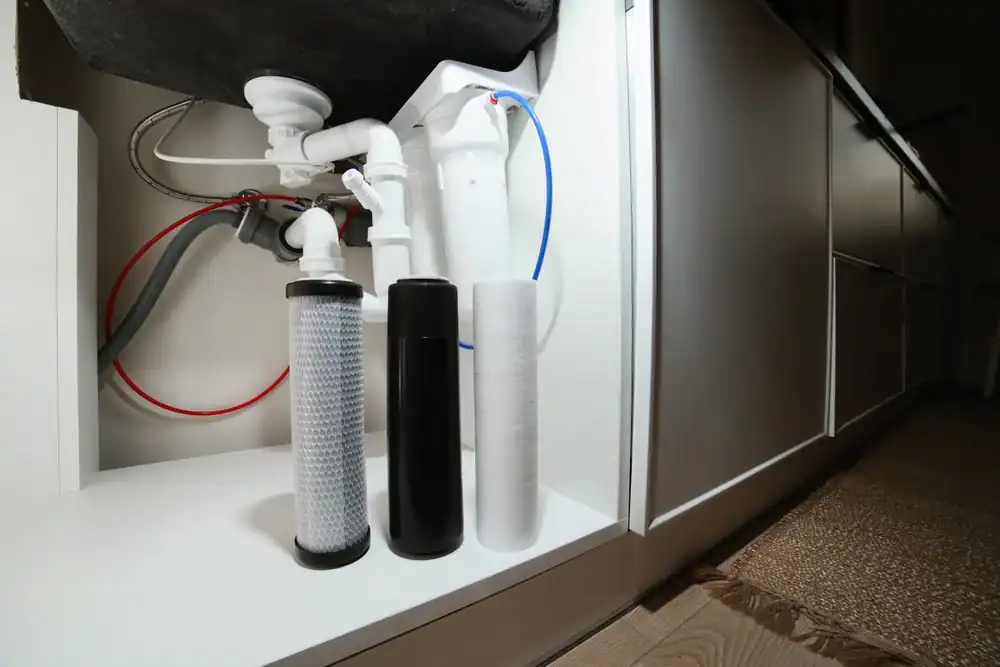
These two systems are often compared like they’re competing for the same job. They’re not. A whole house water filter is installed at the point where water enters your home — the main line — so every faucet, shower, appliance, and hose bib gets treated water. A reverse osmosis system is typically installed under the kitchen sink and treats water at one specific point: usually your drinking and cooking faucet.
That distinction matters a lot. One system protects your plumbing, your water heater, your laundry, and your skin. The other protects what goes into your body. They’re designed to do different things, which is exactly why framing this as an either/or decision tends to lead people in the wrong direction.
Point of Use vs. Whole House Water Filter: Where the Water Gets Treated Changes Everything
The technical terms here are point of use (POU) and point of entry (POE). A whole house system is a POE filter — it treats water before it ever reaches a faucet. An under-sink RO system is a POU filter — it treats water at the moment you use it, at that one location.
Why does this matter for Lake County, FL homeowners? Because the problems showing up in your water aren’t limited to your kitchen tap. If your home is on well water in a rural part of the county — out toward Groveland, Silver Lake, or the areas north of Leesburg — you’re likely dealing with iron and hydrogen sulfide that affect every drop of water in your house. The rust staining on your driveway, the orange ring in your toilet bowl, the smell that hits you the second you turn on the shower — none of that gets fixed by an under-sink RO system. That’s a whole-house problem, and it needs a whole-house solution.
On the other side of the equation, whole house filters — even excellent ones — are not built to remove dissolved contaminants at the same level as a reverse osmosis membrane. Standard whole house systems filter at somewhere between 10 and 30 microns. An RO membrane filters at 0.0001 microns. That’s not a small difference. It’s the difference between catching sediment and catching PFAS compounds, dissolved heavy metals, fluoride, and nitrates.
So if you’re on Leesburg city water and your main concern is what you’re drinking, an RO system at the kitchen sink makes a lot of sense. But if you’re also dealing with hard water — and at 7 to 8 grains per gallon, Leesburg’s water is firmly in the “hard” category — that RO system isn’t doing anything for the scale building up inside your water heater or the spotting on your dishes. You’d still need whole-house treatment for that.
The point is that these systems aren’t rivals. They solve different problems. And in Lake County, FL, most homes have both kinds of problems.
Do I Need a Whole House Water Filter in Florida?
For most Lake County, FL homeowners, the honest answer is yes — and the reasons are specific to this area, not just a generic sales pitch about water quality.
Florida’s water comes primarily from the Floridan Aquifer System, one of the largest and most productive aquifer systems in the world. That limestone geology is why the water here is so consistently hard. Statewide, Florida water hardness typically falls between 100 and 300 parts per million. In Leesburg specifically, the city’s own water quality data puts hardness at 7 to 8 grains per gallon — well into the range that causes real, measurable damage to plumbing and appliances over time.
Hard water doesn’t just leave spots on your glasses. It builds up as scale inside your water heater, reducing efficiency and shortening its lifespan. It clogs showerheads. It wears down washing machine components. Homeowners who have already replaced a water heater early and been told it failed due to mineral buildup know exactly what this costs. A whole house system — whether a filter, a softener, or a combination — addresses this at the source, before the water reaches any of your fixtures or appliances.
For homeowners on private wells in Lake County, FL, the case is even stronger. The county has a significant number of properties in rural and semi-rural areas that rely on well water rather than municipal supply. Well water here often contains elevated iron levels and hydrogen sulfide, produced by bacteria that thrive in the sulfur deposits of the limestone aquifer. These aren’t trace amounts you might miss — they’re the kind of concentrations that turn laundry orange, stain concrete, and make the whole house smell like something went wrong. Treating that at the point of entry, before it gets into your plumbing, is the only practical solution.
If you’re on city water and your main concern is taste, odor, or what you’re drinking rather than appliance protection, you might technically get by without a whole house filter. But even then, Lake County’s hard water makes some form of whole-house mineral management worth considering. The long-term cost of scale damage tends to outpace the cost of prevention.
Point of Use vs. Whole House Water Filter: What Lake County's Water Actually Demands
Here’s where the national comparison guides fall short. Most of them present this as a preference question — do you want filtered water everywhere, or just at the sink? In Lake County, FL, it’s less a preference and more a practical response to what’s in the water.
PFAS compounds were detected in Leesburg’s municipal water supply during the EPA’s Fifth Unregulated Contaminant Monitoring Rule testing program, which ran from 2023 through 2025. The EPA finalized maximum contaminant levels for PFAS in 2024, setting the limit at 4 parts per trillion for PFOA and PFOS individually. While Leesburg’s system is currently in compliance with federal standards, the detection itself is enough to concern health-conscious homeowners — especially those with children or anyone in the household who is immunocompromised.
Standard whole house filters do not remove PFAS at the same level as a reverse osmosis system. For drinking water safety, an RO system certified to NSF/ANSI 58 is the most reliable option available to residential homeowners.
Why Most Lake County, FL Homes Need Both an RO System and a Whole House Filter
When you put the full picture together — hard water from the limestone aquifer, PFAS detected in the municipal supply, iron and sulfur in well water, and the general wear that Florida’s water puts on plumbing and appliances — the question stops being “which system?” and starts being “how do these two systems work together?”
The most practical setup for a Lake County, FL home is a whole house system handling the high-volume, home-wide challenges — mineral content, sediment, iron, sulfur, chlorine — paired with an under-sink RO system delivering purified water at the kitchen faucet for drinking and cooking. Each system does what it’s designed to do. Neither is trying to do a job it wasn’t built for.
This isn’t a sales pitch for buying more equipment than you need. It’s a reflection of what the water here actually contains. A homeowner in Clermont or Mount Dora dealing with hard water and a family that goes through a lot of drinking water has genuinely different needs than someone in a northern state with soft municipal water and mild chlorine. The systems that work for that homeowner aren’t necessarily the systems that work here.
The other thing worth knowing is that combining both systems isn’t as complicated as it sounds. A whole house filter at the main line doesn’t interfere with an under-sink RO — in fact, pre-filtering the water before it reaches the RO membrane extends the membrane’s life and reduces maintenance frequency. They complement each other in a way that single-system setups can’t replicate.
What you don’t want is to buy one system based on a generic guide, discover it doesn’t solve your actual problem, and then have to start over. That’s a frustrating and expensive path. Starting with a water test — one that looks at your specific water chemistry, not just a general contaminant list — is the only way to know what your home actually needs before you spend anything.
Common Questions About RO Systems and Whole House Filters in Lake County, FL
**Does a whole house filter remove the same things as a reverse osmosis system?**
Not at the same level. Whole house filters are excellent at removing sediment, chlorine, iron, sulfur, and particulates that affect taste, odor, and staining. But they filter at 10 to 30 microns, which means dissolved contaminants — PFAS, heavy metals like lead and arsenic, fluoride, nitrates — pass through. A reverse osmosis membrane filters at 0.0001 microns and removes 95 to 99 percent of dissolved solids. The two systems are complementary, not interchangeable.
**Does RO remove hard water minerals?**
Yes, technically — an RO membrane does remove calcium and magnesium. But an under-sink RO only treats the water at that one faucet. It does nothing for the hard water running through the rest of your plumbing, into your water heater, or through your washing machine. For Lake County, FL homes dealing with 7 to 8 grains per gallon hardness, whole-house mineral management is still necessary to protect your appliances and plumbing over time.
**Is reverse osmosis worth it in Florida?**
For drinking water, yes — especially given the PFAS detections in Leesburg’s municipal supply and the general mineral content of Florida water. An RO system gives you drinking water that’s genuinely clean, without the ongoing cost and waste of bottled water. Many families who make the switch are surprised by how much they were spending on bottled water each month.
**What about water pressure — will a whole house filter slow things down?**
A properly sized and installed whole house system should have minimal impact on your water pressure. The key word is properly sized. A system that’s undersized for your home’s flow rate will cause pressure issues. That’s one reason a professional assessment of your home’s water usage and flow rate matters before installation — not just a guess based on square footage.
**How do I know which system my home actually needs?**
Test the water first. The answer is in your water chemistry, not in a comparison article. Leesburg city water and a private well in Groveland are going to test very differently, and the right system for one isn’t necessarily right for the other. A free water analysis gives you actual data to make a real decision — not a guess based on what someone else’s water looked like.

The Right Water Filtration System for Your Lake County, FL Home Starts with Knowing What's in Your Water
Most Lake County, FL homeowners don’t need to choose between an RO system and a whole house filter. You need to understand what each one does — and recognize that Florida’s water conditions often call for both, working together. A whole house system handles the home-wide challenges your water brings in from the limestone aquifer. An RO system handles what you and your family actually drink.
The worst outcome is buying the wrong system for your specific water, realizing it didn’t solve the problem, and starting over. The best outcome starts with a water test that tells you exactly what you’re dealing with before any decisions get made.
We offer a free water analysis and consultation right here in Lake County, FL. We know this area’s water, and we’ll give you a straight answer — not a product pitch. Contact Quality Safe Water of Florida LLC today to find out what’s actually in your water.