Summary:
Most people don’t go looking for a home water filtration system out of curiosity. They go looking because something is wrong. The shower smells off. There’s a rust ring around the toilet that won’t scrub out. The laundry comes out dingy no matter what detergent you use. Or maybe you just moved to Lake County from somewhere with city water, and you’re realizing well water is a completely different animal.
Whatever brought you here, you’re in the right place. We’ll help you understand what your water is actually telling you—and what kind of system is built to fix it.
Iron Smell in Well Water: What That Metallic Odor Means in Lake County
That faint metallic smell coming from your tap isn’t your imagination, and it isn’t your pipes. It’s iron—and in Lake County, it’s one of the most common water quality complaints we hear. The county sits on top of the Floridan Aquifer System, a massive limestone and dolomite formation that’s been filtering and mineralizing groundwater for thousands of years. The result is water that’s naturally rich in dissolved minerals, including iron, long before it ever reaches your faucet.
Iron in water doesn’t always look like anything. It can be completely clear when it comes out of the tap and still leave orange stains on your sink, toilet, and tub within weeks. It can make your morning coffee taste metallic and make your ice cubes smell faintly of rust. At concentrations above 0.3 milligrams per liter—the EPA’s secondary standard—iron starts causing visible damage. Lake County groundwater frequently exceeds that threshold by a significant margin.
High Iron Content in Water: What It Does to Your Lake County Home Over Time
Iron doesn’t just affect the way your water tastes and smells. It works on your home quietly and steadily, and the damage adds up faster than most people expect.
The most obvious sign is staining. Iron oxidizes when it hits air and surfaces—that’s the same process that turns metal rusty—and it leaves behind orange, red, or brown deposits on anything it touches regularly. Toilet bowls, sinks, bathtubs, shower walls, grout lines. Homeowners often spend months buying stronger and stronger cleaning products before realizing the stains keep coming back because the source hasn’t changed.
Laundry is another casualty. Clothes washed in high-iron water come out dingy, sometimes with faint rust-colored streaks, particularly on whites and light fabrics. The iron deposits into the fibers during the wash cycle. No amount of detergent compensates for that.
Then there’s the appliance side of it. Your water heater, dishwasher, and washing machine all run water through their internal components constantly. Hard water with elevated iron accelerates scale buildup inside those components, reducing efficiency and shortening their lifespan. The Water Quality Association has documented that hard water can cut appliance lifespan by 30 to 50 percent and reduce water heater efficiency by up to 25 to 30 percent. For Lake County homeowners, where water hardness typically falls between 100 and 300 parts per million, that’s not a hypothetical risk—it’s an ongoing operating cost.
Iron bacteria is a separate but related problem worth knowing about. Unlike dissolved iron, iron bacteria is a living organism that feeds on iron in your water and produces a slimy, reddish-brown deposit inside pipes and fixtures. If you’ve ever lifted the lid on your toilet tank and seen a slimy, rust-colored coating on the inside walls, that’s iron bacteria. It doesn’t pose a direct health threat at most concentrations, but it clogs pipes, damages fixtures, and makes the water smell even worse. A standard water softener won’t touch it. You need a filtration system specifically designed to address it.
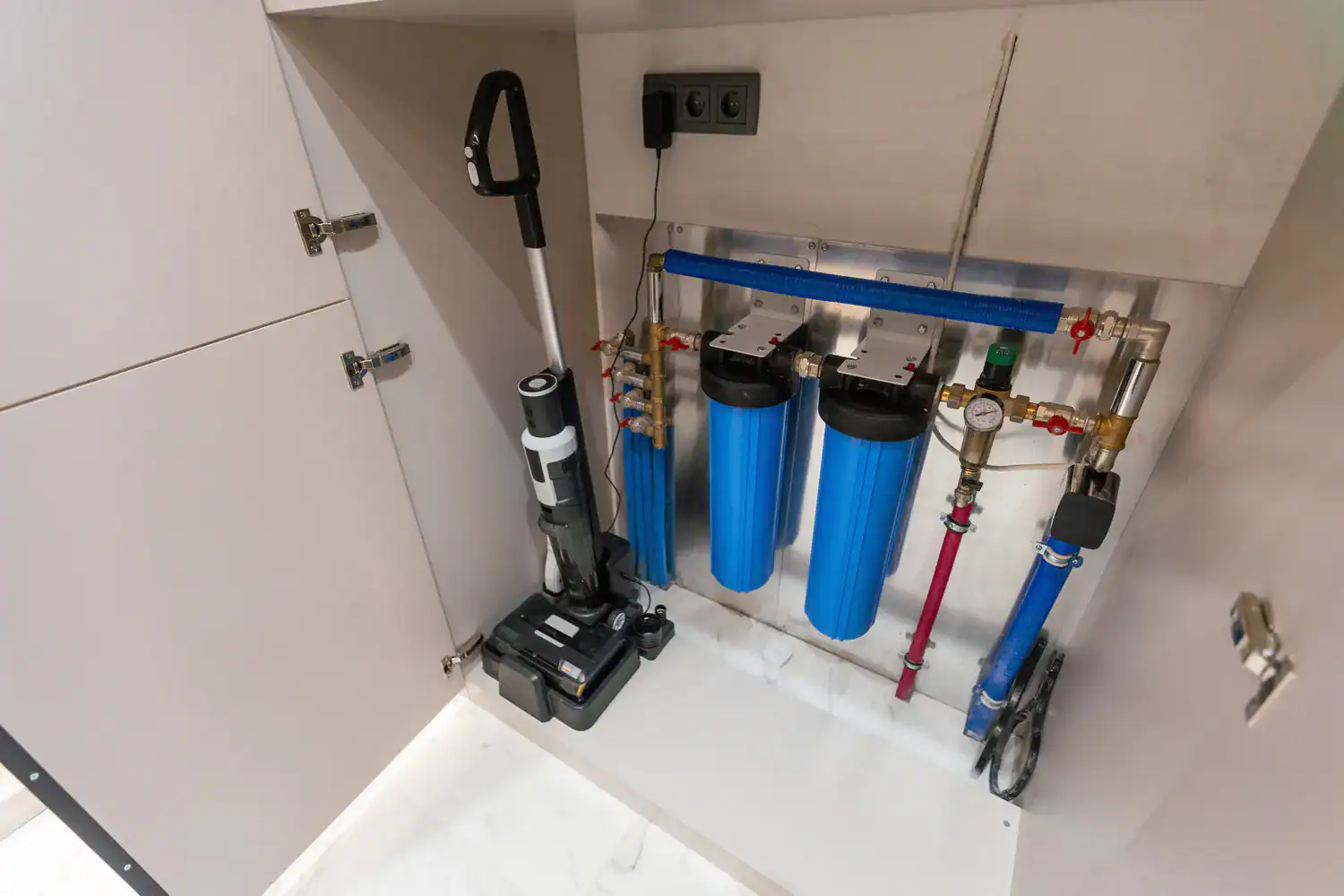
The right home water filtration system for iron problems works at the point of entry—meaning it treats every drop of water that enters your home before it reaches any faucet, appliance, or pipe. That’s the only way to protect the whole house, not just the glass of water you’re drinking at the kitchen sink.
High Sulfur in Water: Why Your Lake County Well Smells Like Rotten Eggs
If the iron smell is subtle and metallic, the sulfur smell is anything but subtle. It hits you the moment you turn on the shower. It’s the smell most people describe as rotten eggs, and it’s caused by hydrogen sulfide gas—a naturally occurring compound that forms in groundwater when sulfur-reducing bacteria break down organic matter in oxygen-poor environments deep underground.
Hydrogen sulfide is detectable by smell at concentrations as low as 0.5 parts per billion. That’s an almost immeasurably small amount, which is why even trace levels create a significant quality-of-life problem. The smell doesn’t mean your water is necessarily dangerous to drink at those concentrations, but it makes the water genuinely unpleasant to use—for bathing, cooking, and anything else.
In Lake County and throughout Central Florida, sulfur in well water is extremely common. The limestone geology of the Floridan Aquifer creates exactly the kind of low-oxygen environment where hydrogen sulfide develops. Homeowners near wetland areas or with deeper wells tend to notice it more, but it can show up in wells across the county regardless of location.
The sulfur smell is also one of the most socially disruptive water problems. You get used to it in your own home faster than you’d expect, but guests notice it immediately. It’s the kind of thing that makes people embarrassed to have company over, or reluctant to serve water from the tap.
A filtration system that addresses hydrogen sulfide needs to be designed specifically for that purpose. Our Sulfur Clear system targets hydrogen sulfide along with the bacteria that produce it—without adding chemicals to the water. It’s not a generic carbon filter with a broad claim. It’s engineered for the specific chemistry that causes the problem. For homes dealing with both iron and sulfur, which is common in Lake County, a whole-house system that handles both simultaneously is almost always the more practical and cost-effective path.
If you’ve tried a pitcher filter or a basic under-sink unit and it didn’t make a dent in the sulfur smell, that’s expected. Those systems aren’t built for hydrogen sulfide removal. The problem has to be addressed at the point of entry—where the water comes into the house—not at a single tap.

Rust Colored Water from Well: What It Means and What Actually Fixes It
Visibly rust-colored or orange-tinted water coming from the tap is one of the more alarming things a homeowner can encounter. It’s also one of the clearest signals that your water has a significant iron problem—either dissolved iron that’s oxidizing in the pipes, iron bacteria, or both.
In Lake County, rust-colored water is most common in homes on private wells, particularly older wells or wells that draw from shallower depths where iron concentrations tend to be higher. It can also appear suddenly in homes that previously had clear water, often triggered by a change in the water table, a period of heavy rain, or a shift in the well’s draw depth. Florida’s rainy season—June through September—is a common time for homeowners to notice sudden changes in water quality, as surface water infiltrates into the groundwater supply.
Is Rust Colored Water from a Well Dangerous?
The honest answer is: it depends on what’s causing it and at what concentration.
Iron itself is not classified as a health hazard at the levels typically found in residential well water. The EPA’s standard for iron is a secondary standard, meaning it’s based on aesthetic concerns—taste, odor, staining—rather than direct health risk. Most homeowners with iron-related rust coloring in their water are dealing with a quality-of-life problem rather than a safety emergency.
That said, iron bacteria can complicate the picture. The bacteria themselves aren’t typically harmful at low concentrations, but they create an environment in your pipes and fixtures that other, more problematic bacteria can thrive in. And if your well water has elevated iron, it’s worth testing for manganese as well—manganese causes dark brown or black staining and has more significant health implications at higher concentrations, particularly for children.
There’s also the PFAS question, which has become increasingly relevant in Florida. Per- and polyfluoroalkyl substances—often called forever chemicals—have been detected in Florida groundwater in various locations, and private well owners are particularly vulnerable because no government agency monitors or regulates private well water quality. Federal and state regulations simply don’t apply to your private well. You’re responsible for knowing what’s in it.
That’s exactly why we start every conversation with a free water analysis. It’s not a scare tactic—it’s an actual analysis of your specific water that tells you what’s present, at what levels, and what it means. Lake County water has its own profile. The water chemistry varies across the county based on well depth, local geology, and proximity to agricultural land. A system designed for one area’s water isn’t automatically right for another. The analysis is how we know which solution actually fits your situation.
Most homeowners who call us have already spent money on cleaning products, replacement appliances, or off-the-shelf filters that didn’t solve the problem. The free water analysis is the step that stops that cycle.
Water Softener vs. Water Filter: Do You Need One or Both?
This is probably the most common question we get, and it’s a fair one because the terms get used interchangeably in marketing even though they describe fundamentally different processes.
A water softener targets hardness minerals—primarily calcium and magnesium. It doesn’t remove iron, sulfur, bacteria, or most other contaminants. What it does is prevent scale buildup in your pipes and appliances, make soap and shampoo lather properly, and stop the white chalky residue that forms on faucets and glassware. In Lake County, where water hardness regularly runs between 100 and 300 parts per million, softening is often genuinely necessary—not just a luxury upgrade.
A water filter is a broader category. Depending on the type and design, a filter can address iron, sulfur, sediment, bacteria, tannins, chlorine, PFAS, and other contaminants. A whole-house filtration system installed at the point of entry treats all the water coming into your home before it reaches any fixture or appliance.
Many Lake County homeowners need both. The water coming out of the Floridan Aquifer is often hard and high in iron and sulfur simultaneously—a combination that requires a system designed to handle multiple problems at once, not a softener alone or a single-stage filter.
We also offer salt-free treatment systems for homeowners who want the benefits of softening without the ongoing salt cost, water waste, or electricity use. Salt-free systems work differently than traditional ion-exchange softeners—they condition the minerals so they don’t form scale, rather than removing them entirely—and they’re a genuinely good fit for certain water profiles and household preferences.
The short version: there’s no universal answer. The right combination depends on what’s actually in your water. That’s why the water analysis comes first. It’s the information you need to make a decision that actually makes sense for your home.
We’ve been doing this work across Lake County for decades. We know the water here. We know how it behaves in Leesburg, FL, in the new construction neighborhoods around Clermont, FL, in the older rural properties outside Eustis, FL. And we’re here after the installation too—for maintenance, filter changes, and any issues that come up—because a system that doesn’t get serviced doesn’t stay a solution for long.

Which Home Water Filtration System Is Right for Your Lake County Well?
If you’ve made it this far, you probably recognize your water in at least one of these descriptions. The iron smell, the rust stains, the sulfur odor, the hard water scale—these aren’t random nuisances. They’re the Floridan Aquifer doing what it does, and they’re not going to improve on their own.
The good news is that all of these problems are solvable. The less good news is that the wrong system—or a system chosen without knowing what’s actually in your water—won’t solve them. That’s the mistake most homeowners make, and it’s an expensive one.
If you’re ready to find out exactly what you’re dealing with, reach out to Quality Safe Water of Florida LLC. The water analysis is free, there’s no pressure, and it’s the only way to know for certain which system is actually built for your water.