Summary:
You’re responsible for your own well water safety in Marion County. No one’s testing it for you. The Florida Department of Health recommends annual testing for bacteria and nitrates, but most homeowners skip it entirely—then spend thousands on a well water filtration system that doesn’t fix their actual problem.
That’s the first mistake, but it’s not the only one. The second is trusting a company that disappears after installation. The third is buying equipment sized for someone else’s house. Each one costs you money, time, and peace of mind.
Here’s what actually goes wrong, and how to avoid it before you buy anything.
Skipping Water Testing Before Choosing a Well Water Filter System
Most people buy a well water filter system based on what their neighbor installed or what a sales rep recommends during a free consultation. That’s backwards. Your water chemistry is different from every other well in Marion County, and the system that works two streets over might be completely wrong for your house.
Without testing, you’re guessing. You might install an iron filter when your real problem is bacteria. Or buy a softener that gets destroyed by high iron levels because you didn’t know iron was even there. The equipment fails, your water still smells like sulfur, and you’re out several thousand dollars.
Testing tells you what’s actually in your water—iron levels, sulfur, bacteria, nitrates, pH, hardness. Once you know that, you can match the right equipment to the actual problem instead of hoping a generic system works.
Water Quality Testing: What Marion County Homeowners Should Test For
A basic well water test should cover the contaminants most common in Central Florida: coliform bacteria, nitrates, iron, sulfur, pH, and hardness. Those six tests tell you whether your water is safe to drink and what equipment you’ll need to treat it.
Bacteria testing is non-negotiable. E. coli and coliform bacteria can enter well water through septic systems, agricultural runoff, or poor well construction. If bacteria is present, no amount of filtration fixes it—you need UV disinfection or chlorination. Testing catches that before anyone in your house gets sick.
Iron and sulfur are aesthetic problems that turn into expensive ones. Iron stains your fixtures, ruins your laundry, and clogs your appliances. Sulfur makes your water smell like rotten eggs. Both are common in Marion County because of the limestone aquifers underneath us, and both require specific treatment systems that won’t work if you’re also dealing with low pH.
pH testing matters because acidic water corrodes copper pipes and prevents iron filters from working. If your pH is below 7, you’ll need an acid neutralizer before you can treat iron. Skip that step and your iron filter fails within months.
Hardness testing shows you how much calcium and magnesium is dissolved in your water. Hard water causes scale buildup in pipes, shortens the life of your water heater, and leaves spots on everything. A water softener handles it, but only if it’s installed after your iron filter—not before.
Nitrate testing is critical if you’re near farmland or septic systems. High nitrate levels are dangerous for infants and pregnant women, and they won’t show up in how your water looks, tastes, or smells. The only way to know is to test for them.
Well Water Testing Requirements in Florida: What You Need to Know
Florida doesn’t require routine testing for private residential wells. You’re not breaking any laws if you never test your water. But you’re also not protected by anyone if something’s wrong with it.
About 88% of Florida residents get water from public systems that are tested and regulated. The other 12%—including most Marion County homeowners on private wells—are on their own. The Florida Department of Health recommends testing for coliform bacteria and nitrates at least once a year, but it’s a recommendation, not a requirement.
That changes if you’re selling your home. FHA, VA, and USDA loans often require well water testing as part of the mortgage process. Lenders want to know the water is safe before they approve the loan. If your water fails testing during a sale, you’re paying to fix it before you can close.
Testing also matters after major events. If you’ve had flooding, a new septic system installed nearby, or repairs done to your well, you should test again. Any of those can introduce bacteria or change your water chemistry enough that your existing treatment system stops working.
The cost of testing is minimal compared to the cost of buying the wrong equipment. A basic bacteria and nitrate test through your county health department runs $20 to $30. A comprehensive test that includes iron, sulfur, pH, and hardness might cost $100 to $150 through a certified lab. Compare that to the $3,000 to $8,000 you’ll spend on a whole-house system, and testing first makes sense.

Choosing the Wrong Water Filtration System for Well Water Chemistry
Even after testing, homeowners still buy the wrong equipment because they don’t understand how different systems work. A water softener doesn’t remove iron. An iron filter doesn’t kill bacteria. A carbon filter doesn’t soften water. Each system has a specific job, and mixing them up means your water problems continue even after you’ve spent thousands on equipment.
The most common mistake is trying to use a water softener to remove iron. Softeners are designed to remove calcium and magnesium—that’s it. If you run water with high iron levels through a softener, the iron coats the resin bed and ruins it. Now you’ve got a broken softener and your iron problem is still there.
Another common mistake is installing an iron filter when your water is acidic. Most iron filtration systems need a pH above 7 to work properly. If your pH is 6.5 or lower, the iron filter can’t do its job. You’ll need an acid neutralizer first, then the iron filter. Get the order wrong and the iron filter fails.
Well Water Filtration Systems: Matching Equipment to Actual Problems
The right system depends entirely on what’s in your water. If your test shows high iron and sulfur, you need an oxidation system that converts dissolved iron and sulfur into particles, then filters them out. That’s usually done with air injection or hydrogen peroxide injection, followed by a catalytic carbon filter.
If your test shows bacteria, you need UV disinfection or a chlorination system. UV light kills 99.99% of bacteria, viruses, and cysts without adding anything to your water. Chlorination works too, but it requires contact time and a carbon filter afterward to remove the chlorine taste.
If your test shows hardness, you need a water softener—but only after you’ve addressed iron and bacteria. Softeners work through ion exchange, swapping calcium and magnesium for sodium. They’re highly effective at removing hardness, but they can’t handle iron, sulfur, or bacteria.
If your test shows low pH, you need an acid neutralizer before anything else. Acidic water corrodes pipes and prevents other treatment systems from working correctly. An acid neutralizer raises the pH using calcite or a blend of calcite and magnesium oxide. Once your pH is above 7, your other equipment can do its job.
Most Marion County homes need multiple systems working together. You might need a sediment filter, an acid neutralizer, an iron and sulfur removal system, a water softener, and a UV filter—all installed in that specific order. Each one handles a different problem, and the order matters because each system protects the one after it.
Water Filtration System for Well Water: Understanding Treatment Order
Treatment order isn’t optional. If you install systems in the wrong sequence, they fail. The general rule is: sediment first, then pH correction, then oxidation (iron/sulfur removal), then softening, then carbon filtration, then UV disinfection.
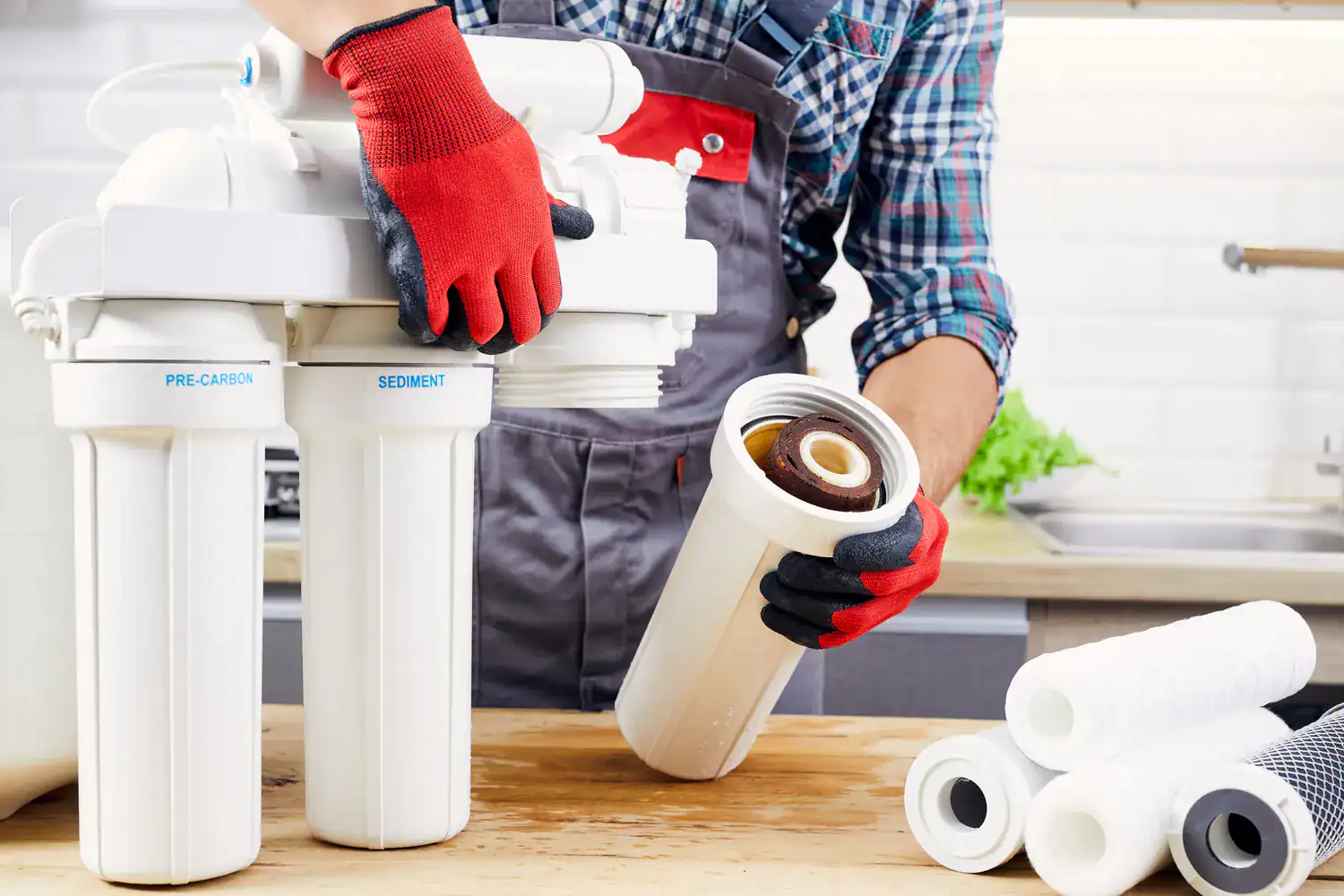
Sediment filters come first because they protect everything downstream. If your well water contains sand, dirt, or rust particles, those need to be caught before they reach your other equipment. A sediment filter prevents clogging and extends the life of your more expensive systems.
pH correction comes next because acidic water prevents iron filters and softeners from working. If your pH is low, you’ll install an acid neutralizer after your sediment filter but before your iron removal system. This raises the pH to a level where your other equipment can function.
Iron and sulfur removal comes before softening because you can’t run high-iron water through a softener. The iron fouls the resin bed and ruins the softener. Remove the iron first, then soften the water.
Carbon filtration comes after softening to remove any remaining chlorine, improve taste, and polish the water. Carbon also provides some protection against PFAS and other chemical contaminants.
UV disinfection comes last because it works best on clear water. If you install UV before your other systems, sediment and iron can block the UV light and reduce its effectiveness. Clean the water first, then disinfect it.
Not Knowing Your Well Pump Flow Rate and Water Pressure
Every well water filter system requires a minimum flow rate to function properly. If your well pump can’t produce enough gallons per minute (GPM), your treatment system won’t backwash correctly, the filter media clogs, and the whole system fails.
Here’s what happens: You buy a system that needs 10 GPM to backwash and clean itself. Your well pump only produces 7 GPM. For the first few weeks, everything seems fine. Then the system tries to run its cleaning cycle, doesn’t get enough flow to lift and clean the media, and starts to fail. The media gets fouled, water quality drops, and eventually the whole thing stops working.