Summary:
If you’ve lived in Lake County for any length of time, you already know something is off with the water. Maybe it’s the smell that hits you in the shower. Maybe it’s the orange ring forming around your toilet bowl no matter how often you clean it. Maybe you just don’t trust what’s coming out of the tap and you’ve been buying bottled water for months without a real plan to stop.
You’re not imagining it — and you’re not alone. Lake County’s water is genuinely different from most of the country, and understanding why matters before you invest in any kind of filtration system.
Why Whole House Filtration Works Differently in Lake County
Most of the United States deals with water quality issues that are manageable with a basic carbon filter or an under-sink unit. Lake County is a different situation. The water here doesn’t just pick up contaminants from aging pipes or agricultural runoff — it starts underground, moving slowly through thick layers of limestone and dolomite before it ever reaches a well or a treatment plant.
That journey leaves a chemical fingerprint. By the time water reaches your Lake County home, it’s often carrying dissolved calcium and magnesium (the source of hard water), iron, hydrogen sulfide, and in some areas, bacteria that thrive in warm groundwater. A whole house water filtration system in Lake County isn’t a luxury upgrade — for many households, it’s the only realistic way to address all of those issues at once, at every tap in the home.
What the Floridan Aquifer Actually Does to Your Lake County Water
The Floridan Aquifer is one of the most productive aquifers in the world, stretching across much of the southeastern United States and sitting directly beneath Lake County. Most of the region’s well water originates here, and the geology it passes through is almost entirely composed of limestone and dolomite — minerals that dissolve into the water as it moves.
The result is naturally hard water throughout Lake County. You see it as white, chalky scale on your showerheads and faucets. You feel it as skin that never quite feels clean after a shower, or laundry that comes out stiff even with extra detergent. Over time, that mineral buildup accumulates inside your water heater, your dishwasher, and your washing machine — quietly reducing efficiency and shortening the lifespan of appliances that cost real money to replace.
Iron is another defining feature of Lake County groundwater. When iron-rich water contacts air inside your plumbing, it oxidizes and leaves behind rust-colored staining on sinks, toilets, and shower surfaces. It’s not a sign that your home is old or poorly maintained — it’s a direct consequence of the local geology. No amount of scrubbing removes it permanently, because the source is still flowing through your pipes every day.
Then there’s hydrogen sulfide. If your water has ever smelled like rotten eggs, that’s what you’re dealing with. It’s produced when sulfur bacteria interact with minerals in the groundwater, and it’s one of the most common complaints we hear from Lake County homeowners — particularly those on private wells. The smell isn’t just unpleasant; it’s embarrassing when guests come over, and it permeates the bathroom and kitchen in ways that feel impossible to escape.
What makes all of this particularly relevant to whole house filtration is that these aren’t separate, unrelated problems. They share a common source — the aquifer — and they’re best addressed together, at the point where water enters the home, rather than one sink at a time.
City Water vs. Well Water: Do Lake County Homeowners on Municipal Service Still Need a System?
This is one of the most common questions we get, and the honest answer is: municipal treatment solves some problems and creates others.
Water treated by a Lake County utility is disinfected before it reaches you — that’s real and meaningful. But the chemicals used to disinfect it, primarily chlorine and chloramines, don’t disappear when the water reaches your tap. They linger. You can smell chlorine in a freshly poured glass of water. You can breathe it in as it evaporates in a hot shower. And when chlorine reacts with organic matter in the water, it produces disinfection byproducts that have their own health implications.
Hard water minerals are also not removed by municipal treatment. The limestone geology that defines Lake County doesn’t stop being relevant just because your water goes through a treatment plant. Communities throughout Lake County — including areas served by larger utilities — still deal with elevated hardness levels that cause scale buildup, shortened appliance lifespans, and the same dry skin and dull laundry that well water users experience.
For homeowners on city water in Lake County, a whole house water filtration system typically focuses on removing chlorine and chloramines, reducing hardness, and filtering out any sediment or disinfection byproducts that make it through treatment. For well water households, the scope usually expands to include iron removal, sulfur treatment, and UV disinfection to address bacteria that municipal systems handle chemically but private wells do not.
The right configuration depends on what’s actually in your water — which is why the first step should always be a water test, not a product recommendation. Anyone who suggests a system before testing your water is guessing.

How Whole Home Water Filtration Systems Work
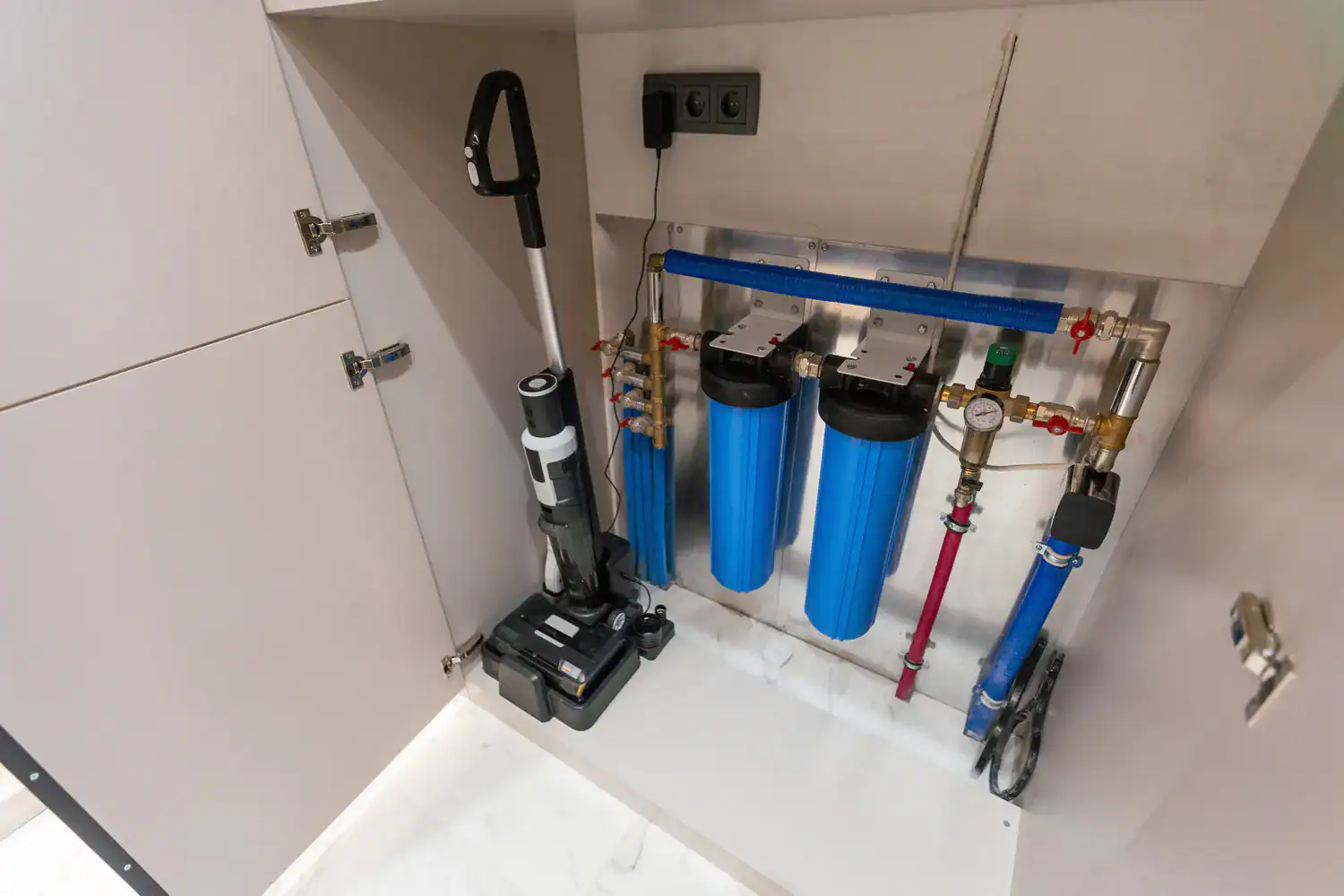
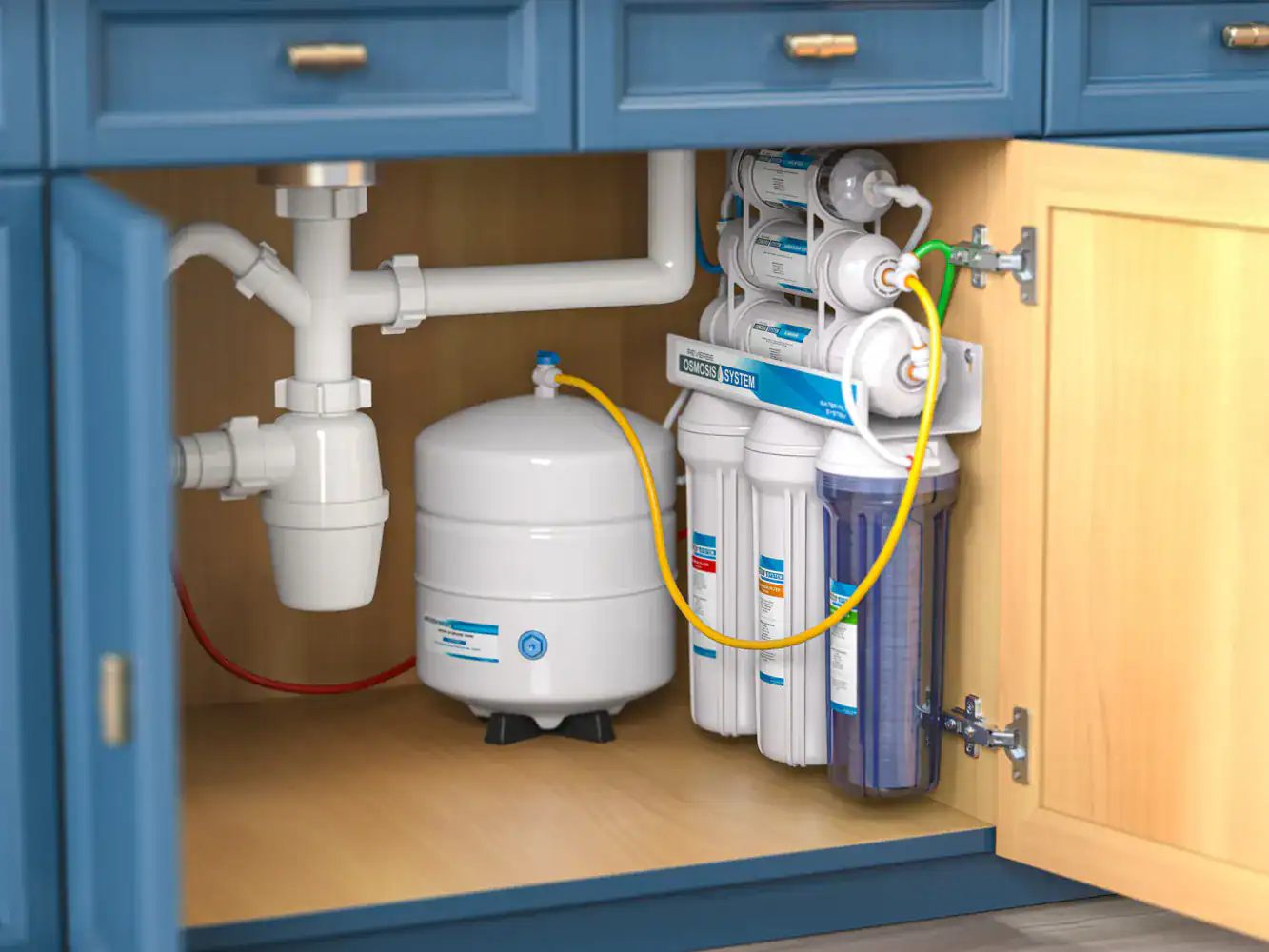
A whole home water filter isn’t a single cartridge sitting under your sink — it’s a point-of-entry system installed at the main water line, which means every tap, every shower, every appliance in the house gets filtered water. The system typically works in stages, with each stage targeting a different category of contaminant.
Understanding the stages helps you evaluate what you’re actually buying, and it makes it easier to ask the right questions when you’re comparing options.
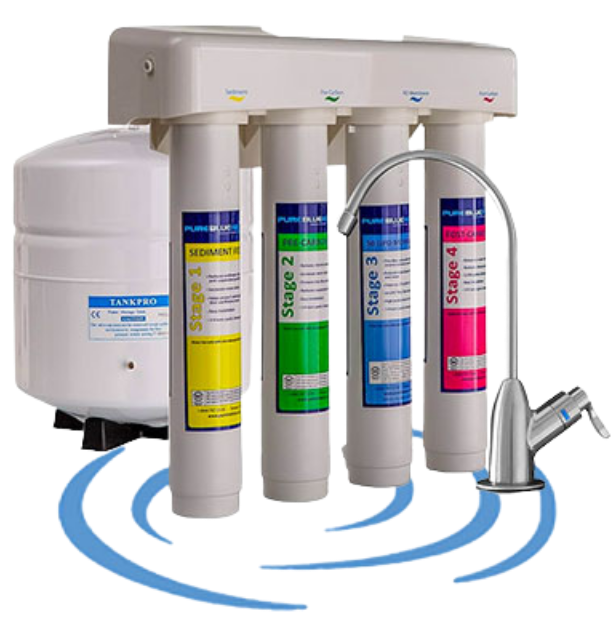
How Whole Home Water Filtration Stages Work Together
Most quality whole house water filtration systems start with a sediment pre-filter. This is the first line of defense — a physical barrier that catches sand, silt, rust particles, and other suspended solids before they reach the more specialized filtration stages downstream. Sediment pre-filters typically need replacement every six to twelve months depending on how much particulate matter is in your source water.
After sediment filtration, the water usually moves through an activated carbon stage. Carbon is exceptionally effective at reducing chlorine, chloramines, volatile organic compounds, and the taste and odor problems that make tap water unpleasant to drink or cook with. For Lake County homeowners on city water, this is often the stage that makes the biggest immediate, noticeable difference — the water simply tastes and smells cleaner.
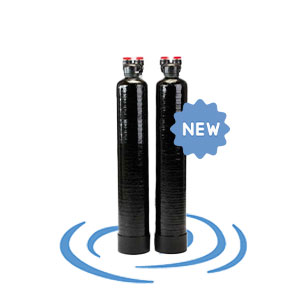
For households dealing with iron or hydrogen sulfide, specialized filtration media handles those issues at a dedicated stage. Iron Clear technology works through natural oxidation to pull dissolved iron out of the water before it has a chance to stain your fixtures. Sulfur Clear systems address hydrogen sulfide at the source, eliminating the rotten egg smell rather than masking it temporarily.
UV sterilization is the final stage in a comprehensive system, and it’s particularly relevant in Florida’s warm climate. A UV system exposes water to ultraviolet light, which destroys the DNA of bacteria, viruses, and other microorganisms — including E. coli and coliform bacteria that can be present in Lake County well water. It does this without adding any chemicals to the water and without affecting taste or odor. The Purelight UV System we install kills 99.99% of waterborne organisms, which matters especially for households with young children, elderly residents, or anyone with a compromised immune system.
The key point is that these stages work as a system. Removing one stage doesn’t just reduce effectiveness in that category — it can allow contaminants to reach and potentially damage the stages downstream. A properly designed system accounts for what’s actually in your water, which is why sizing and configuration should follow a water test, not precede it.
What to Look for When Choosing a Whole House Water Filtration System
The water treatment industry in Florida has a complicated reputation. The Florida Attorney General’s office has prosecuted water treatment companies for fraud and explicitly advises consumers to check BBB records before purchasing a system. That’s a real pattern in this market, and it’s worth taking seriously before you invite anyone into your home to test your water or recommend equipment.
The most important thing to verify is whether the company has a clean, verifiable record with the Better Business Bureau. Not just an accreditation badge on their website — an actual record you can look up, with a rating and a complaint history. Our A+ BBB rating with zero complaints is something we’re genuinely proud of, and it’s something you can verify independently at bbb.org before you ever call us.
Beyond the BBB, look for WQA membership. The Water Quality Association is the primary professional body for the water treatment industry, and membership signals that a company adheres to a code of ethics and stays current with professional standards. NSF-certified components are another meaningful indicator — NSF certification means the equipment has been independently tested to perform as claimed, not just marketed that way.
One thing that often gets overlooked in the buying process is the question of what happens after installation. A system needs maintenance. Carbon filtration media needs replacement every three to five years. Sediment pre-filters need changing every six to twelve months. UV bulbs need annual replacement. If the company that sold you the system isn’t available to service it — or routes your service call through a national call center — that maintenance doesn’t happen, and the system gradually stops working as intended.
We service every system we install. Our technicians are employees, not subcontractors, and we’re available seven days a week. If something needs attention three years from now, you can call the same number and reach the same team.
Whole house water filtration systems in Lake County typically range from $1,500 to $6,000 depending on your home size and water quality issues. Financing is available with low monthly payments for households that want to move forward without the full upfront cost. We also offer a $500 discount for military and first responders — no fine print.
Ready to Find Out What's Actually in Your Lake County Water?
Lake County’s water chemistry isn’t something you can solve with a pitcher filter or a single under-sink cartridge. The Floridan Aquifer, the iron, the sulfur, the bacteria in well water, the chlorine byproducts in city water — these are real, measurable problems that a properly designed whole house water filtration system addresses at the source.
The right first step is a water test. Not a sales pitch, not a product recommendation based on assumptions — an actual test that shows you what’s in your water before anyone suggests a solution. That’s where every conversation we have starts.
If you’re a Lake County homeowner who’s tired of the smell, the staining, or the uncertainty about what your family is drinking and bathing in, Quality Safe Water of Florida LLC is here to help you figure out what you’re actually dealing with — and what it would take to fix it.