Reach Out Today
Please provide your email address so that we can stay in touch and answer any questions you have! We will be reaching back out shortly.


Hear from Our Customers
If you’ve noticed orange staining on your driveway, a sulfur smell when you run the shower, or scale building up on your fixtures, those aren’t random quirks. They’re the Floridan Aquifer telling you exactly what’s in your water. The limestone geology under central Florida loads well water with iron, manganese, calcium, and hydrogen sulfide — and that chemistry doesn’t improve with time.
For Hacienda residents specifically, there’s another layer to this. Many homes here use separate irrigation wells that pull iron-rich groundwater and spray it directly across your driveway, exterior walls, and landscaping. That orange staining isn’t just cosmetic. In a community where homes are maintained to covenant standards, visible staining stands out — and pressure washing it off is just treating the symptom.
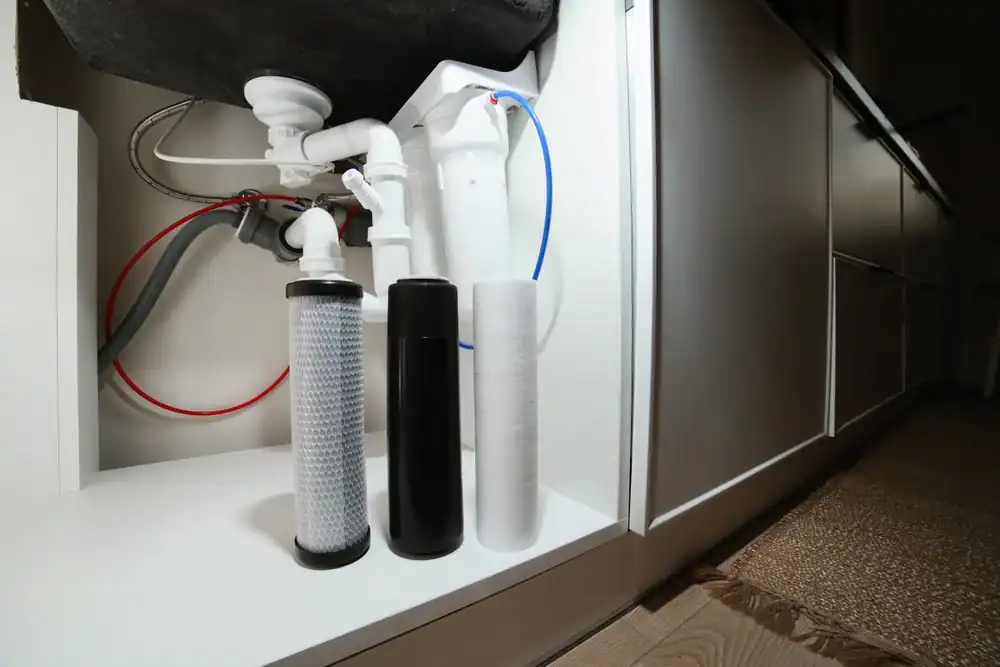
A properly designed whole-house filtration system handles iron removal, sulfur smell treatment, manganese reduction, and bacterial filtration in one installation. Your laundry comes out cleaner. Your appliances last longer. Your water heater stops scaling up. And the staining stops before it starts.
We’ve been treating Florida well water for over 50 years. Not water in general — Florida water. The Floridan Aquifer, the limestone geology, the iron and sulfur issues that catch a lot of northern transplants completely off guard when they move to Hacienda and realize their water here is nothing like what they had back in Ohio or Michigan.
We hold an A+ rating with the Better Business Bureau, a 5-star customer rating, and zero complaints on record. In an industry the Florida Attorney General has had to step in and police for predatory sales practices, that track record means something. We’re also members of the National Water Quality Association — a voluntary professional credential that requires passing a comprehensive exam and committing to a formal code of ethics. That’s not a badge on a website. It’s a standard we’re held to.
We serve Hacienda and the broader Lady Lake and Lake County area through a local 352 number — not a national call center. When something needs attention, there’s a real person to call.
It starts with a free water analysis. One of our technicians comes to your Hacienda home, tests your water on-site, and shows you exactly what’s in it — iron levels, sulfur, manganese, hardness, bacteria if present. No guessing. No sales pitch before the data. You see the results first, and then we have a real conversation about what your water actually needs.
From there, we design a system around your specific water chemistry — not a one-size-fits-all box pulled off a shelf. Central Florida well water has its own profile, and a system built for a home in the Midwest won’t perform the same way here. The Floridan Aquifer runs warmer than northern groundwater, which creates more favorable conditions for iron bacteria and sulfur bacteria to thrive. That matters when sizing and configuring the right equipment.
Installation typically happens in a single day. The system is installed at the point of entry — meaning every tap in your home, every appliance, every shower gets treated water from that point forward. Once it’s in, our technician walks you through how it works and what to expect. There’s no mystery to it, and there’s no disappearing act after the job is done.

Ready to get started?
The most common mistake well owners in this area make is treating one problem at a time — a softener for hardness here, a separate iron filter there, a UV light added later — until the utility room is full of mismatched equipment that still doesn’t fully work. We design integrated whole-house systems that address the complete contaminant profile of your specific well in one properly engineered setup.
For Hacienda homes, that typically means iron removal to stop the staining, sulfur smell treatment to eliminate the rotten egg odor that central Florida’s warm groundwater makes worse, manganese reduction to address what the EWG database has specifically flagged in the Villages of Lake-Sumter water system, and bacterial filtration for homes where private well testing has shown coliform or other biological concerns. Hard water treatment is almost always part of the picture too, given the calcium and magnesium load that comes standard with the Floridan Aquifer’s limestone geology.
Our installations are handled by licensed, insured technicians and comply with Florida Department of Health requirements for water treatment dealers. Because Hacienda falls within the Lady Lake and Lake County district — regulated by the St. Johns River Water Management District — our team is familiar with the local utility structure and what that means for your home’s specific setup. If you’re a veteran, active military, or first responder, we apply a $500 discount directly at installation.

Most homes in the Village of Hacienda are served by the Village Center Service Area utility — so you may not be on a private well for your drinking water. But that doesn’t mean filtration isn’t relevant to your home. The VCSA draws from the same Floridan Aquifer that supplies private wells throughout central Florida, and the EWG Tap Water Database has specifically identified manganese as a contaminant of concern in the Villages of Lake-Sumter water treatment system. Manganese at elevated levels has been linked to neurological effects, particularly in older adults and children.
Beyond that, many Hacienda homes use separate irrigation wells that pull untreated groundwater — loaded with iron and sulfur — and spray it across driveways, exterior walls, and landscaping. That’s where most of the visible orange staining comes from. A point-of-entry filtration or softening system can address hardness and any contaminants coming through the community line, while an irrigation-specific treatment system handles the staining problem at the source. A free water analysis will tell you exactly where you stand.
That smell is hydrogen sulfide — a gas that forms naturally in groundwater when sulfur-reducing bacteria break down organic material in the aquifer. It’s extremely common throughout central Florida, and the Floridan Aquifer’s warm groundwater temperatures make the conditions more favorable for sulfur bacteria than you’d find in cooler northern climates. That’s part of why so many homeowners who moved to Hacienda from up north are caught off guard by it — they’ve never dealt with it before.
The smell isn’t just unpleasant. At higher concentrations, hydrogen sulfide is corrosive to plumbing, fixtures, and appliances. It also makes the water taste metallic or bitter, which affects everything from your morning coffee to your ice cubes. Sulfur smell treatment typically involves an oxidation process — either air injection or chemical oxidation — followed by filtration to remove the byproducts. The right approach depends on the concentration in your specific well, which is why a water test comes first.
The orange staining you’re seeing is oxidized iron — ferrous iron that’s dissolved in your well water becomes ferric iron when it hits air and sunlight, and it deposits as that rust-colored film on concrete, exterior walls, and landscaping. In Hacienda, where homes are maintained to strict covenant standards and curb appeal matters, it’s more than an annoyance.
Pressure washing removes the staining temporarily, but it doesn’t touch the source. The iron is still in your water, and the staining comes right back. The permanent fix is iron removal at the point where the water enters your irrigation system or your home — an iron filter or oxidizing filter that pulls the iron out before it ever reaches your driveway. The right system size depends on your iron concentration and your water flow rate, both of which a water test will confirm. Once it’s in, the staining stops.
The Floridan Aquifer System underlies most of central Florida, including Lake County and the Lady Lake area where Hacienda is located. Because it’s a limestone aquifer, it naturally dissolves and carries high concentrations of calcium and magnesium — which is why hard water is essentially universal in this region. Iron and manganese are also extremely common, both as dissolved minerals and in bacterial form. Hydrogen sulfide is another consistent finding in central Florida well testing.
Bacterial contamination — including coliform bacteria and E. coli — is a concern in any private well system, particularly after heavy rainfall during Florida’s summer rainy season, when surface water can infiltrate shallow wells. PFAS contamination from agricultural and industrial sources is an emerging concern across the Floridan Aquifer system, and awareness of it is growing among homeowners in the region. A comprehensive water test covers all of these — and it’s the only way to know which of them are actually present in your specific well at levels that warrant treatment.
A well-maintained whole-house filtration system generally lasts 10 to 20 years, depending on the type of equipment, the quality of the components, and how consistently it’s serviced. In central Florida specifically, the heavy mineral load in Floridan Aquifer water — high iron, high hardness, often elevated manganese — puts more demand on filtration media and resin beds than you’d see in areas with softer or cleaner source water. That means maintenance intervals matter more here than they might elsewhere.
For Hacienda homeowners, this is particularly relevant because many of the homes in the village were built in the mid-1990s. If your home had a water softener or filtration system installed at original construction, that equipment is now approaching 30 years old. It was also sized and configured based on water chemistry data from three decades ago — not what your well is producing today. A free water analysis will tell you whether your current system is still performing, whether it’s undersized for your actual water conditions, or whether it’s time to replace it with modern equipment designed for what your water actually contains.
Please provide your email address so that we can stay in touch and answer any questions you have! We will be reaching back out shortly.
"*" indicates required fields