Reach Out Today
Please provide your email address so that we can stay in touch and answer any questions you have! We will be reaching back out shortly.

Hear from Our Customers
The white film on your glasses isn’t your dishwasher failing. The dry skin after a shower isn’t your soap. The crusty buildup on your brand-new faucets isn’t a fluke. It’s the water — and in Cason Hammock, every drop coming out of your tap carries the calcium and magnesium load of the Floridan Aquifer, regardless of the fact that Central Sumter Utility has already treated it for safety compliance. Safe to drink is not the same as soft.
When you remove those minerals from the water before it ever reaches your fixtures, a few things happen fast. Dishes come out of the dishwasher actually clean. Showers feel different — your skin isn’t stripped, your hair rinses out completely. Cleaning takes less effort because there’s no mineral residue left behind to scrub. These aren’t small things when you’re dealing with them every single day.
The longer-term math matters too, especially in a newer home like those throughout Cason Hammock. Hard water scale builds up inside water heaters and reduces their efficiency by around 24 percent. It shortens appliance lifespans by 30 to 40 percent across the board. A water heater that should last 10 to 12 years on soft water routinely fails at six to eight years on Florida hard water — that’s a $1,200 to $2,800 replacement you didn’t budget for. You moved into Cason Hammock with new appliances. A water softener is how you keep them that way.
We’re based in Leesburg — Lake County, right next door to Sumter County where Cason Hammock sits — which means we’re not a national company routing your service call through a call center three states away. We know the Floridan Aquifer. We know what Central Florida’s limestone geology does to new appliances over time. And we know Cason Hammock and the newer neighborhoods south of SR 44, where residents are often experiencing Florida water for the first time.
Our A+ BBB rating comes with zero complaints and a 5-star review average across independent platforms. That’s not a marketing claim — it’s a verifiable record you can look up right now. We’re also members of the National Water Quality Association, which holds us to standards most companies in this space simply ignore.
The thing that separates us most clearly from national competitors isn’t a product — it’s what happens after installation. We service what we sell. The same local technicians who install your system are the ones you call when you have a question six months later. That’s not common in this industry, and it should be.

It starts with a professional water analysis — real laboratory testing, not the basic test strips that miss half the picture. For a Cason Hammock home, that means measuring your actual hardness level, iron content, chlorine, and any other factors specific to what Central Sumter Utility or South Sumter Utility is delivering to your address. You get the results. No charge, no obligation.
From there, we size the system to your home. This step matters more than most people realize. A system that’s too small for your household’s daily water usage won’t soften adequately. One that’s oversized regenerates too often and wastes salt and water. We calculate the right fit based on your specific hardness readings, your home’s square footage, and how many people are using the water daily — not a one-size-fits-all guess.
Installation is professional, clean, and handled start to finish by our team. When it’s done, we walk you through exactly how your system operates — how the ion exchange resin works, what the brine tank does, when to add salt, and what to watch for. The system runs automatically from that point forward. The resin beads capture calcium and magnesium ions as water passes through, swap them out for sodium ions, and periodically flush and recharge using the brine solution. Your only ongoing task is adding salt to the brine tank every few weeks. Everything else handles itself.

Ready to get started?
Every water softening installation from Quality Safe Water starts with that free, no-pressure water analysis. What follows is a system recommendation built specifically around your Cason Hammock home — not a package pulled off a shelf because it’s the easiest thing to sell. Central Florida water commonly measures between 7 and 15 grains per gallon of hardness, and the right system for a two-person Patio Villa in Cason Hammock is a different conversation than the right system for a larger Designer Home with higher daily usage. We have that conversation before we recommend anything.
The ion exchange softener itself uses a resin tank and a brine tank. The resin tank is where the actual mineral removal happens — water flows through resin beads that attract and hold calcium and magnesium, releasing sodium in exchange. The brine tank holds the salt solution that regenerates those resin beads on a timed cycle, flushing the captured minerals out and recharging the system automatically. NSF/ANSI 44 certified systems meet the industry’s verified standard for hardness reduction — that’s the certification that actually means something, and it’s what we install.
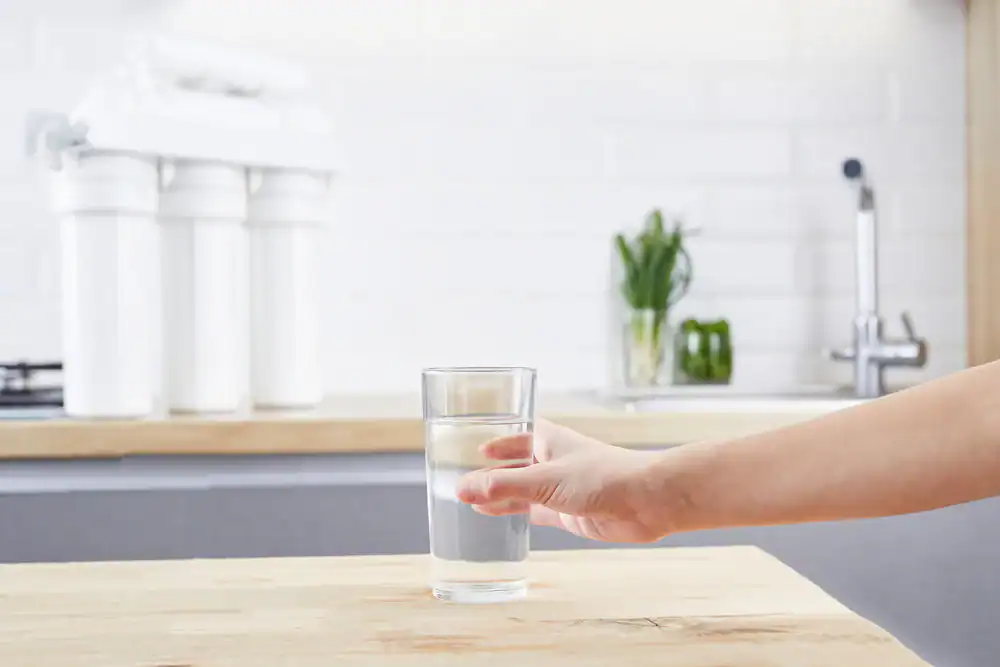
If you have concerns about sodium in your drinking water, a reverse osmosis system at the kitchen tap pairs directly with a whole-house softener and removes virtually everything from what you drink and cook with. We offer both, and we’ll tell you honestly whether you need one, the other, or both — based on your water test, not a sales script. Military families and first responders in Cason Hammock receive $500 off installation, no hoops to jump through.

Yes — and it’s not subtle. Cason Hammock is served by the Sumter County utility system, which draws from groundwater sources running through the same limestone geology that underlies all of Central Florida. The Floridan Aquifer dissolves calcium and magnesium as water moves through it, and those minerals arrive at your tap regardless of the treatment the utility applies. Central Sumter Utility and South Sumter Utility treat water for biological safety and regulatory compliance — they are not required to reduce hardness, and they don’t. Hardness isn’t a regulated contaminant under the Safe Drinking Water Act.
Central Florida water commonly measures between 7 and 15 grains per gallon, which puts it in the moderately hard to very hard range. Home inspectors working throughout The Villages and Cason Hammock routinely document calcification around fixture nozzles as a standard finding. If you’ve noticed white buildup on your faucets or a film on your dishes, that’s exactly what it is.
This is one of the most common questions we get, and the short answer is no — not in any meaningful way. The ion exchange process replaces calcium and magnesium with a small amount of sodium, but the quantity is genuinely minimal. For context, an eight-ounce glass of softened water typically contains less sodium than a single slice of bread. Most people notice no taste difference at all.
That said, if you’re on a sodium-restricted diet or you simply prefer the cleanest possible drinking water, pairing a whole-house softener with a reverse osmosis system at the kitchen sink is the straightforward solution. The RO system removes virtually everything — including the trace sodium — from the water you drink and cook with. We offer both systems and will give you an honest recommendation based on your water test results and your household’s specific needs, not on what generates the bigger sale.
The timing actually makes this more urgent, not less. Hard water damage is cumulative and starts immediately. Scale begins building inside a new water heater’s tank and on its heating elements from the first day it operates on hard water. The same is true for your dishwasher, washing machine, and ice maker. The damage is invisible at first, which is why many new homeowners in Cason Hammock don’t act until they’ve already absorbed real losses in appliance efficiency and lifespan.
A water heater operating on Florida hard water without softening routinely fails at six to eight years instead of its normal ten to twelve — that’s a $1,200 to $2,800 replacement cost that a softener could have prevented. Installing a properly sized system in year one means your new appliances operate the way they were designed to for their full lifespan. Waiting five years doesn’t save money — it just means the scale that’s already built up inside your water heater stays there, and the system you eventually install is working to prevent further damage rather than preventing all of it.
This distinction matters, especially in a market where a lot of products get marketed loosely. A salt-based ion exchange water softener physically removes calcium and magnesium from the water. The minerals are captured by resin beads, flushed out during the regeneration cycle, and gone. Your water comes out genuinely soft — measurably lower in hardness — and stays that way throughout the entire house.
A water conditioner, sometimes called a salt-free conditioner or descaler, doesn’t remove minerals. It changes the form of the calcium and magnesium so they’re less likely to stick to surfaces — but the minerals are still in the water. For Florida’s hardness levels, which commonly run 7 to 15 grains per gallon, a conditioner alone is generally not enough to protect appliances and fixtures the way a true softener does. Salt-based ion exchange is the approach used in roughly 65 percent of installed systems in the U.S. for a reason — it’s the only method that actually takes the minerals out. We’ll tell you which is appropriate for your specific water after we test it.
Day-to-day, the main task is adding salt to the brine tank — typically every four to eight weeks depending on your household’s water usage and your local hardness level. In Cason Hammock, where Central Florida hardness levels run on the higher end, the system regenerates more frequently than it would in a softer-water region, so you may go through salt a bit faster than the manufacturer’s general estimate suggests. Keeping the brine tank adequately filled is straightforward and takes a few minutes.
Beyond salt, a well-installed and properly sized system generally needs professional servicing every few years — checking the resin bed for fouling, inspecting the control valve, and confirming the regeneration cycle is calibrated correctly for your current usage. Resin typically lasts 10 to 15 years before it needs replacement, though iron-heavy water can shorten that timeline. Because we service what we sell, you’re not hunting for a third-party technician who’s never seen your system when that time comes — you call the same company that installed it.
Please provide your email address so that we can stay in touch and answer any questions you have! We will be reaching back out shortly.
"*" indicates required fields