Reach Out Today
Please provide your email address so that we can stay in touch and answer any questions you have! We will be reaching back out shortly.

Hear from Our Customers
When you are on a private well in Salt Springs, nobody is treating your water before it reaches your tap. Marion County Utilities does not filter, chlorinate, or monitor private well water the county’s own website directs well owners to the Florida Department of Health for testing guidance. What comes out of your faucet is exactly what the Floridan Aquifer delivers: water that has traveled through ancient limestone and picked up every mineral along the way.
You can taste it. You can see it on your faucets. And if you have been in your Salt Springs home for a few years, you have probably seen it inside your water heater too.
A reverse osmosis system removes 95 to 99 percent of dissolved solids including the elevated sodium, potassium, and magnesium that are specific to this aquifer. That means water that tastes neutral and clean instead of faintly mineral or salty. It means the white scale stops building up on your fixtures. It means your water heater, your dishwasher, and your ice maker stop absorbing a slow, steady dose of mineral damage every single day.
For homeowners in Salt Springs Village or along County Road 316 near Lake Kerr where a lot of the housing stock was built in the 1960s and 1970s the appliance protection argument alone is worth paying attention to. Older plumbing and older equipment are more vulnerable to mineral-rich water, not less. Getting the water right protects everything downstream from it.
We are not a plumbing company that sells water treatment on the side. Water purification, filtration, and softening is our entire business nothing else. That focus matters when you are dealing with well water in a place like Salt Springs, where the mineral profile is specific, documented, and unlike most of what you find elsewhere in Florida.
You need someone who has worked with Floridan Aquifer water before, not someone applying a generic package they learned last quarter.
We hold an A-rating with the Better Business Bureau, a 5-star score, and zero complaints on record a public record you can verify yourself at bbb.org before you ever make a call. We are also a member of the National Water Quality Association, which means ongoing access to the training and standards that keep our recommendations grounded in real water science.
We offer a $500 discount for active military, veterans, and first responders which in a community like Salt Springs, with a strong veteran presence throughout Marion County, is not a small thing.

It starts with a real water test. Not a quick strip that tells you your water is hard actual lab-grade analysis of what is in your water: hardness, iron, sulfur, pH, total dissolved solids, sodium, and more.
For Salt Springs well owners who have never had their water professionally tested, this is the most useful thing we can offer before recommending anything. The test drives the system recommendation. If your water needs a whole-house reverse osmosis system, you will know exactly why. If a simpler setup addresses your specific problem, that is what you will hear.
Once the analysis is complete, the right system gets sized and specified for your home and your actual water chemistry. Installation is handled by technicians who work exclusively in water treatment not generalists running a side service. For homes in unincorporated Marion County, there are no unusual permitting barriers to residential RO installation, but the work is done to code and with the kind of care that comes from doing this every day.
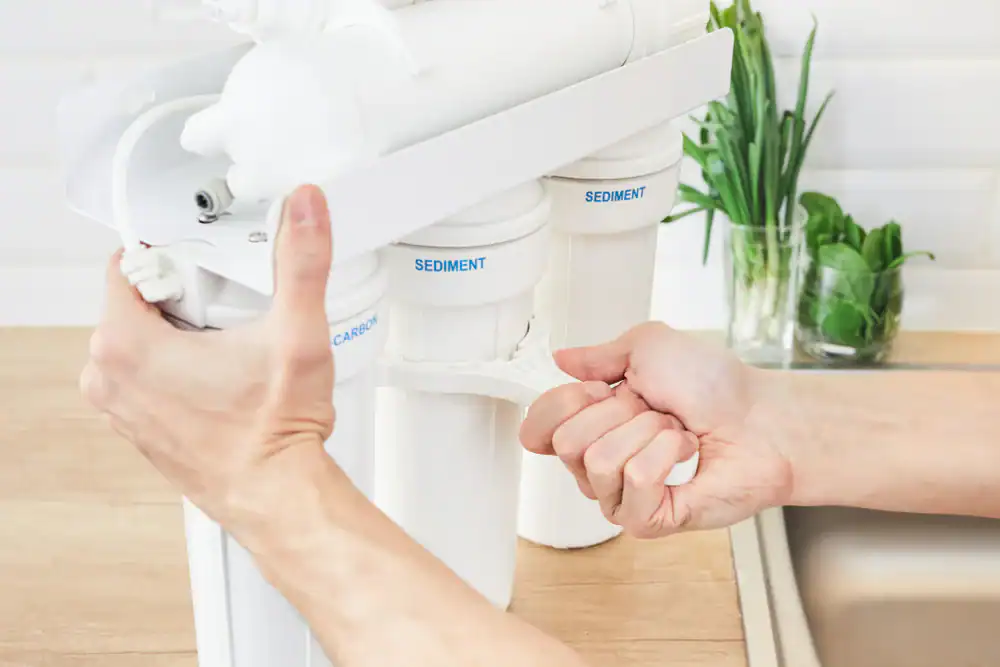
After installation, you will know how to maintain the system, when filters need replacing, and who to call when that time comes. We service what we sell. Annual maintenance runs roughly $100 to $200 in filter replacements, and the membrane typically lasts two to five years. The system itself, properly maintained, is built to run for 15 to 20 years.
Ready to get started?
Salt Springs well water is not a one-problem situation. The aquifer delivers elevated minerals, potential iron, possible hydrogen sulfide that faint rotten egg smell on hot water and dissolved solids that a basic pitcher filter or refrigerator cartridge was never designed to handle.
The system recommended for your home depends on what the water test finds, not on what fits a standard package.
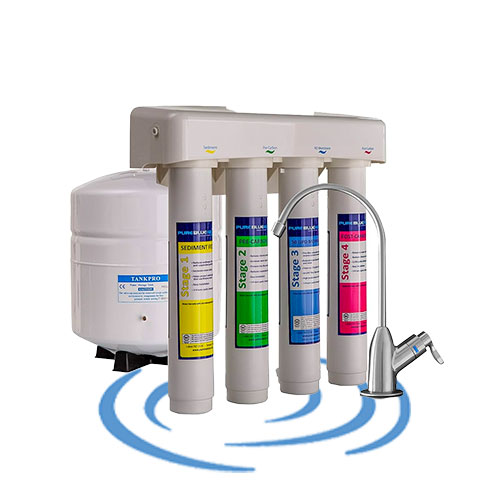
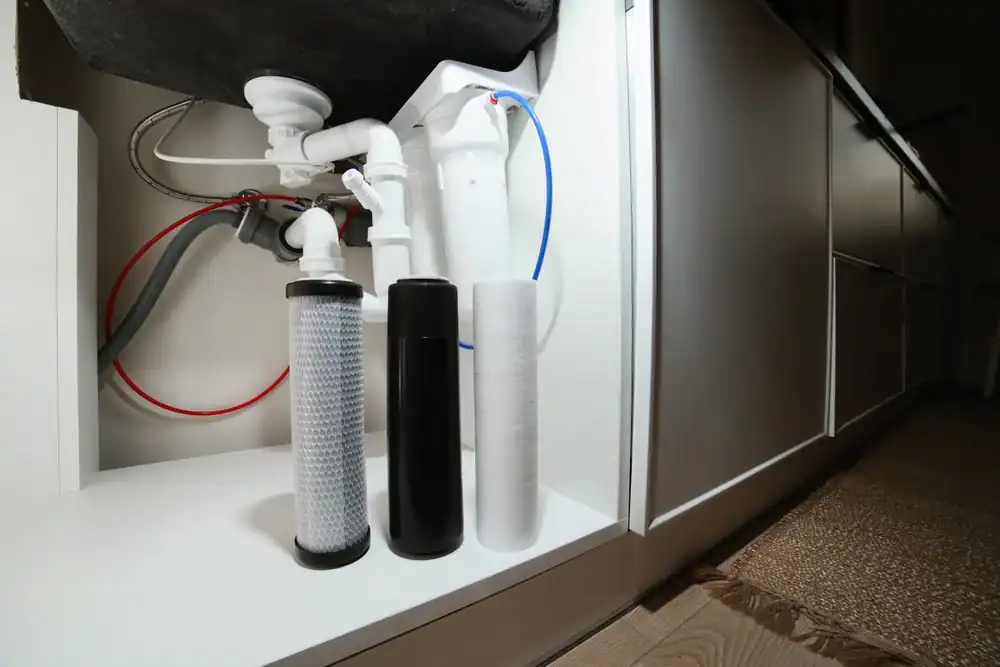
For most Salt Springs homeowners, an under-sink reverse osmosis system addresses the drinking and cooking water problem directly. It filters at 0.0001 microns smaller than any bacterium, virus, or dissolved chemical and produces clean, neutral-tasting water at the tap where you use it most.
For homes with more severe contamination, or where the mineral load is affecting the whole house, a whole-house reverse osmosis system is the higher-level solution. That is where we consider our specialty to be, and it is the type of system that makes the most difference in older homes with aging plumbing that has already absorbed years of aggressive well water.
Either way, the system is matched to your water, your home, and your usage. No upsell to something you do not need. No undersized system that cannot keep up with what your well is delivering. If you are a veteran or active military, the $500 discount applies here and if you are a first responder serving Marion County, the same discount is yours.
Technically, well water in Salt Springs is not automatically unsafe but it is also completely unmonitored and untreated before it reaches your tap. Marion County Utilities does not manage or test private well water. The Florida Department of Health in Marion County is the agency that handles private well guidance, and they recommend testing your well water regularly, particularly after major storm events or flooding.
Salt Springs sits within and adjacent to the Ocala National Forest, surrounded by wetlands and river systems including the Ocklawaha River. After a significant hurricane or heavy rain event, surface water contamination of private wells is a real and documented risk in this area not a theoretical one.
Beyond storm-related contamination, the Floridan Aquifer’s limestone geology naturally delivers water with elevated dissolved minerals, potential iron, and in some cases hydrogen sulfide. None of these make your water immediately dangerous, but elevated sodium and dissolved solids in drinking water are a long-term health consideration particularly for older adults and anyone managing blood pressure or kidney function.
A professional water test is the only way to know what is actually in your well, and it is the right starting point before deciding whether treatment is necessary and what kind.
Salt Springs takes its name from something real. The aquifer beneath this community carries an unusually high concentration of potassium, sodium, and magnesium drawn from the limestone rock the water travels through. Marion County’s own documentation notes that the salinity of Salt Springs is higher than any other spring in the lower and middle reaches of the St. Johns River.
If your well is drawing from that same aquifer which it is you are tasting exactly what the geology delivers. That mineral flavor is not a sign of contamination in the traditional sense, but it is a sign of elevated total dissolved solids that a standard filter will not remove.
Reverse osmosis is the appropriate solution for this specific problem. An RO membrane filters at 0.0001 microns and removes 95 to 99 percent of dissolved solids, including the sodium, potassium, and magnesium that give Salt Springs water its characteristic taste. After installation, the water coming out of your tap will taste neutral the way water should taste. Most homeowners notice the difference immediately, and most stop buying bottled water within the first week.
A reverse osmosis membrane removes dissolved solids, heavy metals, nitrates, sulfates, sodium, fluoride, chlorine, PFAS compounds, arsenic, and most bacteria and viruses. For Salt Springs well owners, the most relevant contaminants are the ones the Floridan Aquifer naturally delivers: elevated minerals, dissolved solids, potential iron, and hydrogen sulfide.
But the list of what RO removes goes well beyond what you can taste or smell. PFAS the so-called forever chemicals have been detected in Florida groundwater and are a growing public health concern statewide. Nitrates from agricultural runoff can reach private wells in rural Marion County. Arsenic occurs naturally in Florida’s limestone geology. None of these have a detectable taste or odor.
A standard pitcher filter or refrigerator cartridge does not remove PFAS, arsenic, nitrates, or dissolved minerals at meaningful levels. An RO membrane does. That distinction matters for Salt Springs homeowners who are on private wells with no municipal treatment standing between the aquifer and their glass.
Under-sink reverse osmosis systems for drinking water typically run between $300 and $800 for the unit itself, with professional installation adding to that depending on your existing plumbing setup. Whole-house reverse osmosis systems which treat all the water entering your home, not just the kitchen tap generally start around $3,000 and go up from there depending on system capacity, pre-treatment requirements, and the specific conditions of your well water.
For Salt Springs homes with severe mineral contamination, iron, or sulfur issues, pre-treatment components are often necessary before the RO membrane, and those add to the overall investment.
The more useful number to think about is the long-term cost comparison. If you are currently buying bottled water, you are likely spending $600 to $1,200 per year on something an under-sink RO system replaces permanently. Add the cost of appliance damage from mineral-rich water a water heater replacement in an older Salt Springs home is a significant unbudgeted expense and the ROI case for a properly installed system is straightforward.
We will walk you through the math before you commit to anything. If you are a veteran, active military member, or first responder, the $500 discount applies and should factor into your comparison.
Reverse osmosis works with well water and in many cases, it is more necessary on a well than on city water. Municipal water systems provide at least baseline treatment: chlorination, pH adjustment, and regulatory monitoring. Private wells provide none of that. Whatever the aquifer delivers is what you get.
For Salt Springs homeowners, that means water with an elevated mineral load, potential iron and sulfur, and no treatment buffer between the ground and your tap.
The one thing to understand about RO on a well is that pre-treatment often matters more than it does on city water. High iron levels can foul an RO membrane quickly if not addressed upstream. Hydrogen sulfide the rotten egg smell some Salt Springs residents notice on hot water needs to be handled before the water reaches the membrane.
This is exactly why we start with a water test rather than a standard package. The test identifies what is in your specific well, and the system is built around those results. A properly configured well water RO system, with the right pre-treatment in place, will last for years and perform consistently but getting the configuration right at the start is what makes that possible.
Please provide your email address so that we can stay in touch and answer any questions you have! We will be reaching back out shortly.
"*" indicates required fields