Reach Out Today
Please provide your email address so that we can stay in touch and answer any questions you have! We will be reaching back out shortly.

Hear from Our Customers

If you’ve been scrubbing the same white crust off your faucets for years, or your skin feels dry no matter how much lotion you use, the water is the problem — not your cleaning routine. Pinellas County Utilities’ own data puts local water hardness between 196 and 249 parts per million. That’s well into the “very hard” range, and it’s affecting every faucet, fixture, and appliance in your home around the clock.
For homeowners in Dunedin’s older neighborhoods — the bungalows near Edgewater Drive, the mid-century homes along Patricia Avenue — this isn’t a new problem. It’s a decades-old one that’s been compounding inside your pipes the entire time. Hard water scale narrows pipe diameter over time, reduces water pressure, and accelerates corrosion in plumbing systems that were already aging before the problem started.
Soft water changes the daily experience in ways you’ll notice fast. Your showerhead actually flows the way it’s supposed to. Glassware comes out of the dishwasher clear. Skin and hair feel different after the first week — genuinely different, not marginally. And behind the walls, your water heater, washing machine, and plumbing are no longer fighting a mineral buildup they were never designed to handle. That’s not a small thing when you’re protecting a home you’ve invested in.
We are a dedicated water treatment company — not a plumbing company that installs softeners on the side. Every system we sell is one we’re prepared to service, and that distinction matters more than most people realize until they need it.
Our A+ BBB rating carries zero complaints. Not a few. Zero. In an industry where high-pressure sales tactics and post-sale disappearing acts are genuinely common, that record exists because we don’t operate that way. We’re also members of the National Water Quality Association — a credential that requires real adherence to professional standards, not just a fee.
We serve Pinellas County and know Dunedin’s water conditions specifically. When we talk about 10 to 15 grains per gallon hardness in Dunedin homes, we’re not pulling that from a generic Florida brochure — that’s Pinellas County Utilities’ own documented data, and it’s what we size your system against. Military families and first responders also receive $500 off — because the people serving this community deserve clean water as much as anyone.

It starts with a real water analysis — not a test strip, not a sales prop. We test your water for hardness, iron, chlorine, sulfur, and other contaminants specific to what’s coming through your tap. Pinellas County’s regional water supply draws from the Alafia River, Hillsborough River, and the C.W. Bill Young Regional Reservoir, and while it’s treated before it reaches your home, the mineral content stays high enough to cause significant damage over time. Knowing exactly what’s in your water is the only way to size a system correctly.
Once we have your results, we calculate the right system for your home based on actual usage, household size, and your specific hardness level — not a catalog recommendation. An undersized softener won’t keep up with Pinellas County’s documented mineral load. An oversized one wastes salt and water. Getting that number right is the difference between a system that works and one that disappoints.
Installation is professional and thorough. Our Platinum Plus Water Softener uses salt-based ion exchange — the only technology that actually removes calcium and magnesium from your water rather than just altering how they behave. Resin beads inside the tank capture those minerals and hold them until the system regenerates automatically, flushing them out through the brine tank cycle. Once it’s in, the maintenance is simple: add salt when the tank needs it, and the system handles the rest. Most systems we install last 15 to 20 years.

Ready to get started?
Our Platinum Plus Water Softener is engineered for whole-house performance — meaning every tap, every shower, every appliance in your home gets treated water from the moment it’s installed. It’s designed to handle both hardness minerals and iron, which matters in Pinellas County where both show up in the water supply.
For homes near Honeymoon Island or along the Dunedin Causeway, the combination of hard water and coastal salt air creates an accelerated corrosion environment that standard fixtures and appliances weren’t built to withstand long-term. Soft water removes one significant variable from that equation. For the older homes in Dunedin’s historic core — where original or aging plumbing is already under stress — stopping the scale accumulation now prevents the kind of damage that becomes a much larger repair conversation later.
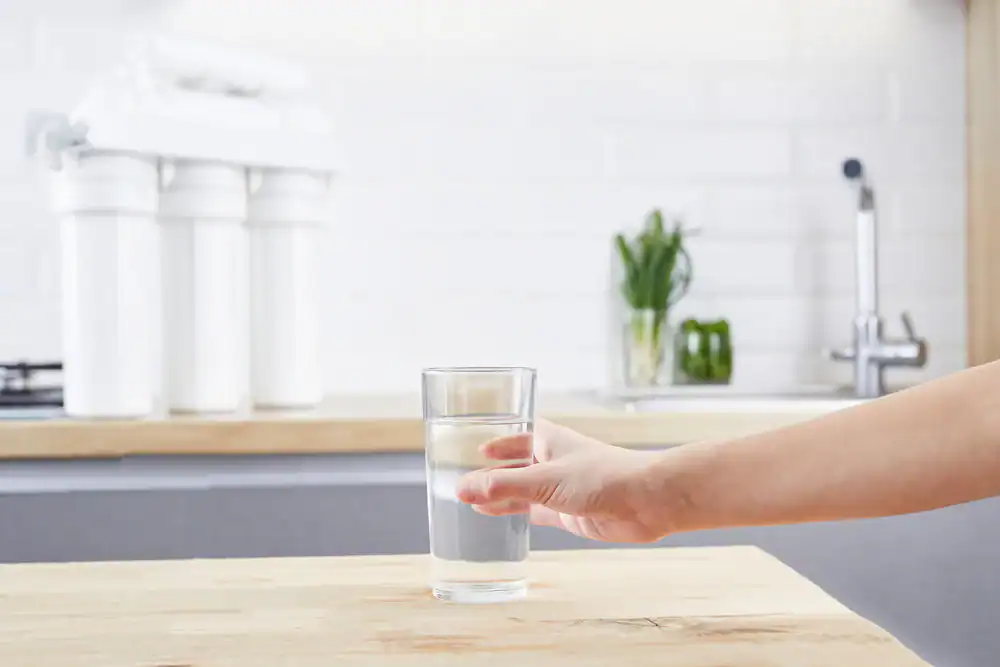
If your water quality needs go beyond hardness alone, our whole-house filtration systems and Purelight UV purification work alongside the softener to address chlorine, sediment, and biological contaminants in a single integrated setup. Reverse osmosis is also available for drinking water at the kitchen tap. Every recommendation we make starts with your actual water test results — not an assumption about what your zip code probably needs. We don’t offer plumbing or water heater services, so there’s no upsell agenda here. Just water treatment, done right.

Dunedin receives its water from Pinellas County Utilities, and the county’s own documented data puts hardness levels between 196 and 249 parts per million — equivalent to roughly 11 to 15 grains per gallon. The Water Quality Association classifies anything above 10.5 grains per gallon as “very hard.” So Dunedin’s water sits squarely in that range across virtually every measurement point in the county.
Whether you personally need a softener depends on your home’s specific situation — the age of your plumbing, your appliances, how long you’ve been on city water, and what symptoms you’re already seeing. A free professional water analysis will give you the exact number at your tap, not just the county average. If your water doesn’t need treatment, we’ll tell you that directly. But if you’re already seeing scale buildup on fixtures, dealing with dry skin after showers, or replacing appliances earlier than expected, those are signs the mineral content is already doing damage.
Ion exchange is the process that actually removes calcium and magnesium from your water — not just changes how they behave, but pulls them out entirely. Inside the softener tank, resin beads carry a sodium charge. As hard water passes through, the calcium and magnesium ions swap places with the sodium ions and bond to the resin. What comes out the other side is genuinely soft water, not conditioned hard water.
For Pinellas County’s documented hardness levels — up to 249 ppm — this matters. Salt-free conditioning systems are marketed heavily in Florida, and they do reduce scale formation in certain conditions. But they don’t remove the minerals. Your water is still technically hard, your skin and hair still feel the effects, and scale can still form in high-temperature environments like water heaters. At Pinellas County’s hardness levels, salt-based ion exchange is the approach that actually solves the problem at the source.
Hard water scale accumulates inside pipes over time, and in Dunedin’s older neighborhoods — the historic homes near downtown, along Patricia Avenue, or off Edgewater Drive — that accumulation has often been building for decades. Scale narrows the internal diameter of pipes gradually, which reduces water pressure, makes the plumbing work harder, and creates conditions where corrosion accelerates. By the time you notice the pressure drop, the damage is already significant.
Installing a whole-house water softener stops new scale from forming immediately. It won’t reverse what’s already built up, but it prevents the problem from continuing — which in an older Dunedin home is often the more urgent priority. Soft water is also less corrosive to metal pipes and fixtures than hard water, so the plumbing that’s still in good condition stays that way longer. For homeowners in Dunedin who have already invested in kitchen or bathroom renovations, soft water protects those new fixtures from day one.
The honest answer is: not much. The main thing you’ll do is add salt to the brine tank periodically — how often depends on your household’s water usage and the hardness level coming into your home. In Dunedin, where Pinellas County water runs between 196 and 249 ppm, a typical household might add a 40-pound bag of salt every four to six weeks. The system handles regeneration automatically on a set schedule, flushing the captured minerals out of the resin bed and recharging it for the next cycle.
Beyond salt, an annual check of the system’s settings and resin condition is good practice — especially in Florida’s warm climate, where water heaters run harder and mineral deposition happens faster than in cooler regions. We service what we install, so if something ever needs attention, you’re calling the same company that put the system in — not a third-party contractor who’s never seen your setup. Most systems we install are built to last 15 to 20 years with basic upkeep.
Softened water is safe for the vast majority of people. The ion exchange process replaces calcium and magnesium with a small amount of sodium — the amount added is proportional to how hard your incoming water is. At Pinellas County’s hardness levels, the sodium added by softening is modest and well within safe consumption ranges for most adults. If someone in your household is on a sodium-restricted diet, a doctor’s guidance is worth seeking, but for most families it’s a non-issue.
If you want completely sodium-free water at the kitchen tap specifically, the straightforward solution is a reverse osmosis system at the drinking water faucet. RO removes virtually everything — including the trace sodium from the softening process — and delivers clean, mineral-free drinking water separately from the whole-house supply. We offer residential RO as a companion to our softening systems, and it’s a common combination for Dunedin homeowners who want the full picture covered.
Please provide your email address so that we can stay in touch and answer any questions you have! We will be reaching back out shortly.
"*" indicates required fields