Reach Out Today
Please provide your email address so that we can stay in touch and answer any questions you have! We will be reaching back out shortly.

Hear from Our Customers
You stop buying bottled water. Your guests stop making that face when they turn on the faucet. The orange stains disappear from your toilets, sinks, and tubs—and they stay gone.
Your appliances last longer because they’re not fighting through iron buildup and sulfur corrosion every single day. Water heaters that should last 10 years don’t die at year six. Washing machines stop leaving rust spots on your clothes.
The smell goes away. Not just covered up—gone. You can shower without holding your breath, and your home stops smelling like something died in the pipes every time someone runs the water.
That’s what happens when you treat the problem at the source instead of masking it with filters that can’t keep up.
Quality Safe Water of Florida has an A+ rating with the Better Business Bureau and zero complaints. We’re members of the National Water Quality Association, which means we follow actual standards—not just sales scripts.
We’ve been handling Florida well water for years, and Windhover’s water issues aren’t new to us. The limestone geology here loads your groundwater with iron and sulfur. The sandy soil and high humidity make it worse. We know what’s in your water before we test it, and we know how to fix it.
We don’t do plumbing. We don’t install water heaters. We do water treatment, and that’s it. When you call us, you’re getting people who actually know how hydrogen sulfide forms in Florida aquifers and why your current setup isn’t cutting it.
First, we test your water. Not a guess, not a visual inspection—a real test that tells us what’s in there and how much. Iron levels, sulfur levels, bacteria, pH, hardness. You can’t fix what you don’t measure.
Once we know what we’re dealing with, we recommend a system that matches your water chemistry. If you’ve got high iron, we might use air injection oxidation to convert dissolved iron into particles we can filter out. If hydrogen sulfide is the issue, we’ll look at oxidation methods or hydrogen peroxide injection depending on your levels and your water usage.
The system gets installed at your main water line, so every faucet, every shower, every appliance gets treated water. No more point-of-use filters that only work in one spot. Whole-house means whole-house.
After installation, the system runs automatically. You’re not adding chemicals every week or babysitting equipment. Modern filtration systems handle the work—you just use the water. We’ll walk you through maintenance during install so you know when to check things and what to look for, but these systems are built to run without constant attention.

Ready to get started?
You get a filtration system designed for Florida well water—not a one-size-fits-all unit that works in Michigan but fails here. Iron removal systems that use oxidation to turn dissolved contaminants into solids, then filter them out before they reach your home.
Hydrogen sulfide treatment that eliminates the rotten egg smell at the source. Not masking it with carbon filters that wear out in three months—actually removing it. Air injection oxidation systems that are chemical-free and use oxygen to do the heavy lifting.
If bacteria is the issue, we’ll address disinfection. Iron bacteria and sulfur bacteria don’t just smell bad—they create biofilm in your pipes and foster conditions where other bacteria thrive. A proper system handles that.
In Windhover, you’re dealing with Florida aquifer water, which means higher mineral content and more bacterial activity than most places. Your system needs to account for that. The limestone and sandy soil here allow contaminants to enter groundwater easily, and summer heat makes hydrogen sulfide levels spike. We size and spec systems based on what actually happens in Central Florida—not what works in a textbook.
You also get someone who answers the phone when something goes wrong. We’re not a national company that sells you a system and disappears. We’re local, and we service what we install.

Hydrogen sulfide gas. It forms when bacteria break down organic matter in oxygen-depleted groundwater, which is common in Florida’s limestone aquifers.
The smell is unmistakable—rotten eggs, sulfur, something dead in your pipes. It’s not just unpleasant, it’s embarrassing when guests visit. And it’s not something you can scrub away or cover up with air fresheners.
The bacteria that produce hydrogen sulfide thrive in Florida’s warm, mineral-rich groundwater. Windhover sits on geology that’s loaded with sulfur compounds, giving bacteria plenty of fuel. During summer months, when temperatures rise and groundwater oxygen levels drop, hydrogen sulfide levels spike. That’s why the smell often gets worse in warmer weather.
Treating it means oxidizing the gas and filtering it out before it reaches your faucets. Carbon filters can mask the smell temporarily, but they don’t remove the source—they just buy you a few weeks before the odor comes back.
They oxidize dissolved iron so it becomes a solid particle, then filter it out. Dissolved iron is invisible when it comes out of your well, but it oxidizes when it hits air—that’s what causes the orange stains.
Air injection oxidation systems inject oxygen into your water line, which converts ferrous iron (dissolved) into ferric iron (solid). Once it’s solid, a filter media traps it before the water enters your home. No iron reaches your faucets, your appliances, or your laundry.
Some systems use hydrogen peroxide injection instead of air, especially if you’re dealing with high iron levels or iron bacteria. Peroxide is a stronger oxidizer and handles tougher contamination, but it requires chemical storage and monitoring.
Florida well water often contains iron levels above 0.3 mg/L—the EPA’s secondary standard. At those levels, you’ll see staining, taste metallic water, and deal with sediment buildup in your water heater and appliances. Left untreated, iron reduces appliance lifespan by 30 to 50 percent. A water heater that should last 10 years fails at six because it’s packed with iron sediment.
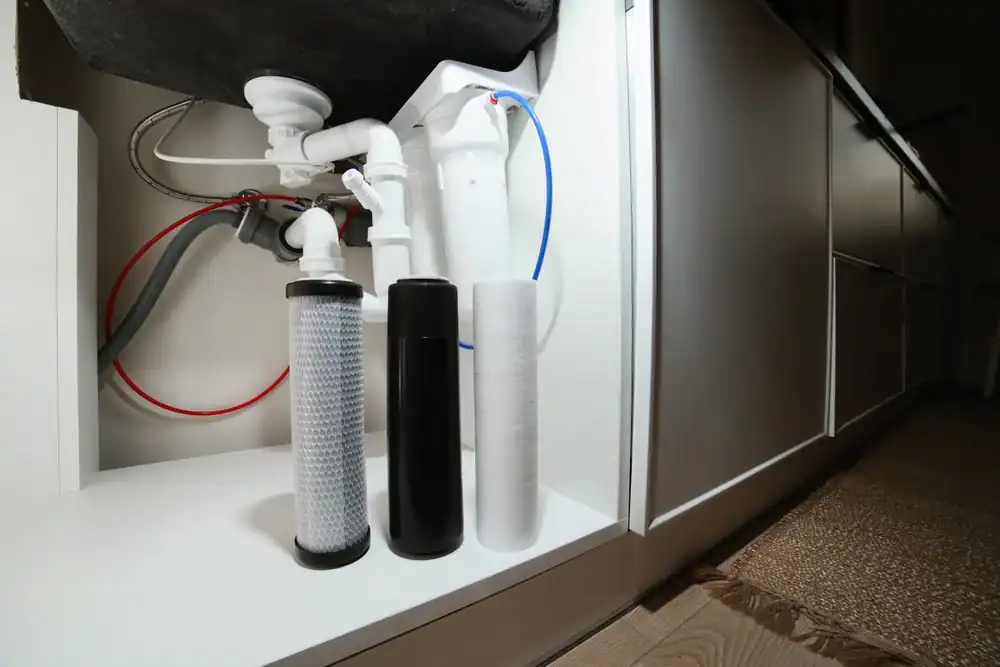
If you’ve got iron, sulfur, or bacteria in your well water, point-of-use filters won’t cut it. They can’t handle the volume or the contamination levels, and they don’t protect your appliances.
A whole-house system treats water at the main line before it reaches any fixture or appliance. That means your water heater isn’t filling with iron sediment. Your washing machine isn’t spraying rust-colored water on your clothes. Your showers don’t smell like sulfur.
Point-of-use filters—like the ones you screw onto a faucet or install under a sink—are designed for light polishing, not heavy contamination. They clog fast, need constant replacement, and they don’t stop your water heater from corroding or your toilet from staining.
Whole-house systems cost more upfront, but they protect everything. And in Florida, where well water contamination is the rule rather than the exception, a whole-house approach is the only one that makes financial sense. You’re either treating the water or replacing appliances every few years.
Depends on the system and your water quality, but most need a filter change or media replacement every one to three years. Some systems backwash automatically and need even less attention.
Air injection systems are low-maintenance. They use oxygen to oxidize contaminants, so there’s no chemical to refill. The filter media lasts years if it’s sized correctly for your water usage and contamination levels. You’ll need to check the air compressor occasionally and replace the media when it stops performing, but that’s not a monthly task.
If you’ve got a hydrogen peroxide injection system, you’ll need to refill the peroxide tank periodically—usually every few months depending on water usage. The system will alert you when it’s low.
Sediment filters and carbon filters need more frequent changes, especially if your water has high iron or particulate levels. A sediment filter might need swapping every six months if your water is heavily contaminated.
The key is sizing the system correctly from the start. Undersized systems work harder, clog faster, and need more maintenance. A properly sized system handles your water volume and contamination levels without constant intervention. We’ll walk you through the maintenance schedule when we install your system so you know what to expect and when to check things.
Yes, but it depends on the type of bacteria and the treatment method. Iron bacteria and sulfur bacteria are common in Florida wells, and they require oxidation and filtration to remove. Coliform bacteria and E. coli require disinfection.
Iron bacteria don’t make you sick, but they create slimy biofilm in your pipes and water heater. They also produce rust-colored slime and contribute to that rotten egg smell. Treating them means oxidizing the bacteria and filtering out the biofilm before it reaches your plumbing.
Sulfur bacteria produce hydrogen sulfide gas, which is what causes the rotten egg odor. They thrive in low-oxygen environments, which is exactly what Florida’s deep aquifers provide. Oxidation systems eliminate sulfur bacteria by introducing oxygen or peroxide into the water, killing the bacteria and removing the gas they produce.
If your water tests positive for coliform bacteria or E. coli, you need disinfection—usually UV light or chlorination. Coliform bacteria indicate that surface contamination has entered your well, which means your water isn’t safe to drink until it’s treated. UV systems kill bacteria as water passes through, and they’re chemical-free and low-maintenance.
A water test tells you what you’re dealing with. Don’t guess. If bacteria is present, the wrong treatment won’t fix it—and you’ll keep drinking contaminated water thinking you’re protected.
Please provide your email address so that we can stay in touch and answer any questions you have! We will be reaching back out shortly.
"*" indicates required fields