Summary:
You’ve seen the marketing. Crystal-clear water from every faucet. Your kids bathing in the same purity you’d drink. Complete protection from everything lurking in Marion County’s water supply.
Whole house reverse osmosis sounds like the answer to every water worry you’ve ever had. And for some homes dealing with serious contamination, it absolutely is. But for most Marion County families, it’s a $10,000+ solution to a $3,000 problem. The difference comes down to what’s actually flowing through your pipes right now, not what could theoretically be there.
Before you drain your savings account, you need to know what you’re solving for and whether there’s a smarter way to get there.
What a Whole House Reverse Osmosis System Actually Is
A whole house reverse osmosis system treats every drop of water entering your home—showers, toilets, washing machine, outdoor hose, everything. It’s installed at your main water line, before water branches off to different fixtures.
The process is the same as the small RO unit under your kitchen sink, just scaled up dramatically. Water gets forced through a semi-permeable membrane with pores measuring 0.0001 microns. For perspective, that’s small enough to block viruses. Contaminants get flushed down the drain while purified water moves into storage.
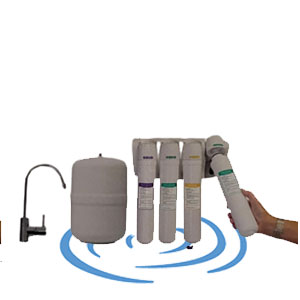
The infrastructure required is substantial. You’re looking at commercial-grade RO membranes producing 500 to 1,500 gallons daily, storage tanks holding 165 to 550 gallons, repressurization pumps maintaining 40 to 60 PSI throughout your home, and pretreatment equipment protecting those expensive membranes. It’s a water treatment plant in your garage.
How whole house systems compare to under sink reverse osmosis
An under-sink RO system costs $200 to $600 installed and treats 50 to 100 gallons daily—enough for drinking, cooking, and coffee. It fits in a cabinet. Annual maintenance runs about $100 to $200.
Whole house systems start around $5,000 and often hit $10,000 to $15,000 once you add necessary pretreatment. They need dedicated space for tanks and equipment. Professional installation alone costs $500 to $2,000 because you’re integrating into your main line, not just tapping into a cold water pipe.
The water usage difference is significant. Under-sink units waste maybe 10 to 20 gallons daily in a typical household. Whole house systems can waste 300 to 600 gallons daily depending on your family’s water use and the system’s efficiency ratio. In Marion County, where we’re under Phase II water shortage restrictions as of February 2026, that wastewater adds up on your bill and strains already-limited resources.
Maintenance scales up too. You’re changing pre-filters every 6 to 12 months, RO membranes every 2 to 5 years, and monitoring storage tanks and pumps. Annual upkeep typically costs $400 to $700 versus the $100 to $200 for a kitchen unit. Over a 10-year period, you’re looking at $4,000 to $7,000 in maintenance alone.
That’s why the question isn’t whether whole house RO works—it does. The question is whether you need that level of treatment for water that’s washing your car or filling your toilet.
What gets removed by whole house reverse osmosis systems
Reverse osmosis removes 95 to 99 percent of dissolved contaminants that slip right through standard filters. Heavy metals like lead, arsenic, chromium, and mercury. Nitrates that contaminate well water from agricultural runoff and pose serious risks to infants. Total dissolved solids that make water taste off or leave white film on everything.
It handles fluoride, which carbon filters can’t touch. PFAS—those forever chemicals showing up in Florida water supplies—get reduced significantly. Sulfates, pesticides, herbicides, volatile organic compounds, and pharmaceutical residues all get blocked by the membrane.
The system also removes chlorine, chloramines, and the chemical taste that comes with municipal water treatment. But here’s the thing—a $600 whole-house carbon filter removes chlorine too, without the cost and complexity of RO.
That’s the critical point most homeowners miss. RO removes everything, whether you need it removed or not. If your Marion County water doesn’t have arsenic, you’re paying thousands of dollars for arsenic removal you don’t need. If nitrates aren’t in your water test, that capability adds zero value to your life.
A $200 water test tells you exactly what’s in your supply. Without that information, you’re guessing. And guessing wrong costs you $10,000.
Best Whole House Reverse Osmosis System Features That Matter
If your water test shows contamination that genuinely requires whole house RO, choosing the right system protects your investment. The cheapest option costs you more through constant repairs, poor performance, and early replacement.
Capacity needs to match your household’s peak demand. A family of four typically needs 800 to 1,000 gallons per day. Larger families or homes with high usage patterns need 1,500 GPD or more. Undersized systems can’t keep up, leaving you with low pressure or running out of treated water during peak times.
Component quality determines whether your system lasts 10 years or 20. Stainless steel housings resist corrosion better than plastic. Industrial-grade pumps handle continuous operation without failing. USA-made systems typically use higher-quality components and you can actually get replacement parts when you need them, unlike imported systems where you’re waiting weeks for a $40 filter from overseas.
Pretreatment requirements that protect your investment
Here’s what catches most homeowners off guard. The RO system is maybe half of what you’re actually buying. Pretreatment often costs as much as the RO unit itself, and without it, you’ll destroy expensive membranes in months instead of years.
RO membranes are sensitive equipment. Chlorine degrades them. Hard water minerals clog them. Iron and manganese foul them. Sediment scratches them. Marion County water typically measures 7 to 15 grains per gallon hardness—that’s moderately to very hard water. Run that through an RO membrane without softening it first, and you’re looking at membrane replacement every 6 months at $400 to $800 per membrane.
A whole-house water softener costs $1,000 to $3,000 installed. It’s not optional if you have hard water. It’s required equipment that protects a much larger investment. Municipal water needs carbon pre-filtration to remove chlorine before it hits the RO stage. Well water often requires sediment filters, iron removal, sometimes sulfur treatment depending on your water test results.
Each pretreatment component adds to your upfront cost and creates another maintenance item on your schedule. But skip it and you’ll spend more replacing damaged membranes than you would have spent on proper pretreatment.
A complete system properly configured for typical Marion County water conditions—hard water, some chlorine, normal sediment—often runs $8,000 to $15,000 installed. That’s the real number, not the advertised price for the RO unit alone.
When whole house RO makes sense versus smarter alternatives
Whole house reverse osmosis is the right call when you have specific contaminants that can’t be removed any other way and you need that purification throughout your home. High nitrate levels in well water. Arsenic above safe limits. Extremely high total dissolved solids. PFAS contamination that affects more than just your drinking water.
Homes in areas with documented groundwater contamination from agricultural chemicals or industrial activity may genuinely benefit from point-of-entry RO treatment. If your water test shows multiple serious contaminants requiring comprehensive removal, the investment makes sense.
But most Marion County homes don’t have that situation. Your water test probably shows hard water, some chlorine taste from municipal treatment, maybe iron staining if you’re on a well. Those are real problems worth solving—they just don’t require whole house RO to solve them.
A better approach for typical water issues combines targeted solutions. Install a whole-house water softener ($1,500 to $3,000) to handle the hard water damaging your pipes, water heater, and appliances. Add whole-house carbon filtration ($600 to $1,500) to remove chlorine, improve taste, and eliminate that chemical smell when you shower. Then put a quality reverse osmosis system under your kitchen sink ($400 to $800) for purified drinking and cooking water.
Total investment: $2,500 to $5,300. You’ve solved your hard water problem throughout the home. You’re showering in chlorine-free water. Your drinking water is as pure as whole house RO would make it. And you’ve saved $5,000 to $10,000 compared to whole house RO while using a fraction of the water.
The maintenance is simpler too. Each system operates independently. If your water softener needs service, it doesn’t shut down your drinking water. When you change RO filters, you’re not affecting your whole house. And you’re not paying to purify water that’s just going to water your lawn or wash your car.
For 8 out of 10 homeowners, this targeted approach delivers better results for less money. You’re matching the treatment to the actual use instead of over-engineering everything to drinking water standards.
Making the Smart Water Treatment Decision for Your Home
Whole house reverse osmosis isn’t right or wrong—it’s right for specific situations and expensive overkill for most. The difference comes down to what your water test shows, not what you’re afraid might be there.
Start with professional water testing. Spend $200 to $500 to know exactly what contaminants you’re dealing with before you spend $10,000 on equipment. If you have serious contamination requiring RO-level treatment throughout your home, invest in a properly sized system with correct pretreatment and professional installation. If your issues are typical Marion County concerns—hard water, chlorine, drinking water quality—targeted solutions probably save you thousands while solving your actual problems.
Either way, work with a company that properly tests your water first, sizes equipment based on real data instead of sales quotas, and has the certifications and reputation to back up their recommendations. We bring WQA-certified professionals, A-rated BBB standing with zero complaints, and over 50 years of combined experience to every project in Marion County, FL. We specialize in properly engineered systems matched to your specific water conditions, not one-size-fits-all solutions that leave you with buyer’s remorse.